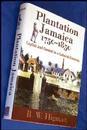
Title: Plantation Jamaica (1750-1850) Capital and Control in a Colonial Economy
Author: B. W. Higman
Reviewer: Barbara Nelson
Publisher: University of the West Indies Press
TREVOR BURNARD of the University of Sussex says of Plantation Jamaica 1750 - 1850: "A sustained tour de force of superb scholarship that deals with an extremely important and hitherto lightly examined topic in Jamaican history in a way that will shape academic discourse on plantation Jamaica for a generation."
It is indeed a scholarly work, but presented in such a way that the average person who is interested in West Indian history and the history of slavery will enjoy reading (and learning from) it.
"(It is) among the best recent writings on these topics," says Stanley Engerman of the University of Rochester.
B.W. Higman is William Keith Hancock professor of history at the Australian National University and a fellow of the Royal Historical Society and the Academy of the Social Sciences in Australia.
He has written a number of award-winning publications including Slave Population and Economy in Jamaica, 1807 1834.
ROLE OF ATTORNEYS
Plantation Jamaica 1750 - 1850 examines the role of the attorneys who managed estates chiefly for absentee proprietors.
Higman compares the attorney Simon Taylor's management of Golden Grove Estate, established in 1734 (one of a series of sugar estates strung along the floodplain of the Plantain Garden River) and Isaac Jackson's control of Montpelier.
Taylor managed Golden Grove between 1765 and 1775 (the decade before the American Revolution) in the period called the 'Silver Age' of West Indian history. This was the time when the system of plantation slavery was in its most mature and profitable form.
His task "was to manage a vicious system of labour exploitation and to extract the greatest possible product from the enslaved people forced to live and work on the estate." He was successful in achieving that goal.
Isaac Jackson controlled Montpelier in the years immediately following the abolition of slavery. Montpelier was much larger than Golden Grove and incorporated a variety of land types. That estate was founded in 1739, while Golden Grove was founded in 1734.
The book has nine chapters. After Chapter 1 - Planters and Proprietors, it is divided into two parts -; Part 1: Managers and Part 2: Managing.
It is further divided as follows:-
Chapter 2: Managerial Hierarchies
Chapter 3: Planting Attorneys
Chapter 4: Keeping Accounts
Chapter 5: Communicating
In Part 2: Managing
Chapter 6: Two Attorneys
Chapter 7: Managing Golden Grove, 1765-1775
Chapter 8: Managing Montpelier, 1839-1843
Chapter 9: Honour Among Thieves
IMPORTANT POINTS
Among the important points brought out in chapter one are that in 1805 Jamaica exported almost 100,000 tons of sugar, more than any other country. In 1810, it led the world in coffee.
Jamaica was at that time a mature slave society with nine of every 10 people enslaved. The slave owners concentrated their resources on export crops, especially sugar and employed the gang system of field labour.
By the middle of the 18th century, the sugar planters of Jamaica were some of the richest men in the world made rich by slavery.
We read in chapter two of the rise of absentee planter, proprietors. Each of these needed to employ an individual to manage the business of what had become a complex transnational enterprise. This person was the attorney.
The fundamental laws directed at attorneys were passed by the Jamaican legislature in 1740 and 1751. Generally, by the end of the 18th century, a class of managers and/or attorneys operated most British Caribbean estates.
Attorneys were mostly literate white men whose knowledge was generally derived from employment in supervisory roles on sugar estates. The attorney was responsible for just one property.
I found chapter five (Communicating) particularly informative as the author describes how writing was done by hand using a quill dipped in ink on 'linen or European' paper; goes into writing technologies, the diffusion of information within Jamaica, the newspapers, inland post, the mails of Jamaica and the development of post roads.
Later, the reader is informed about the movement of merchant ships, the seasonal rhythms of merchant shipping as well as that of packet boats, and so on.
MANAGERIAL ACTIVITIES
The next three chapters go into more detail about the two attorneys - Simon Taylor (the attorney for Chaloner Arcedeckne) and Isaac Jackson (attorney for Lord Seaford).
Both men lived most of their lives in Jamaica and died here. They never married and, while they served several masters, their managerial activity was dominated by their most prominent employers.
Higman writes that Richard B Sheridan found that in 1775 absentees and minors owned 30 per cent of the sugar estates of Jamaica and that these properties produced 40 per cent of the island's sugar and rum.
He concludes in the final chapter that "it was the management practised by the attorneys that squeezed the maximum possible product from the system and the people it oppressed. Together, proprietor and attorney created a system of management as modern as it was repugnant."


















