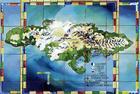
Carol Crichton, 'Land we love'.
The following is part 2 of an interview with Dr. Eddie Chambers, curator of the exhibition 'Curator's Eye II, Identity and History: Personal and Social Narratives in Art'. The exhibition is currently on show at the National Gallery. Here he discusses his work with Dr. Jonathan Greenland, Executive Director of the National Gallery of Jamaica.
Dr. Eddie Chambers: I find Ebony Patterson confrontational. She has these large images of naked black women in the exhibition. They definitely evoke nakedness rather than nudity. In many ways they are the antithesis of the conventional woman as depicted in advertising, the media etc.
Ebony's work in some ways might amount to a declaration of identity that flies in the face of proscribed and choking notions of femininity. The bodies in Ebony's work are deviant, naked, raw, and unvarnished, and we simply cannot ignore these monumental, imposing bodies.
I could of course be wrong, but it seems to me that to be black in Jamaica is not - in and of itself - entirely seen as beautiful or respectable. The image that Jamaica projects, the celebration of the 'Browning', Jamaica's colour-coding (as I would call it), all these things imply that hybridity makes beautiful. This in turn implies that what is perceived as being 'undiluted' African is in some way less 'beautiful'. It seems to me that there is great beauty in the figures in Ebony's work. Not a conventional notion of beauty and perhaps not a mainstream Jamaican notion of beauty, but beauty nonetheless.
Jonathan Greenland: How does Chris Irons fit in to the theme?
EC: I see the two dogs as a metaphor of the Jamaica Labour Party and the People's National Party (PNP). One body with two heads. For such a relatively young country, one thing that continually dismays me is the two party system in Jamaica. They became entrenched so rapidly. I listen to the radio, read the newspapers, and the hegemony of the JLP and PNP is never, ever questioned. In a democracy the people deserve more than a choice between Tweedle-dee and Tweedle-dum. In the U.S.A and U.K. it is the same of course. You can either vote Republican or Democrat, Conservative or Labour, but the political tribalism is not such a problem. In Jamaica it is a problem and has caused the shedding of so much blood. I see the Chris Irons piece as symbolising a dysfunctional system at war with itself, with ordinary people, poor people as the victims of this constant political warfare.
JG: What about Andrae Green?
EC: The strange thing is I've always found when I'm in Jamaica that Cuba and Haiti might as well be somewhere near Australia, even though they are near neighbours. Jamaica is isolated in its anglophilia. It is surrounded by Cuba, Mexico, and Haiti and yet there is a real language barrier. Andrae's work is all about Haiti. This painting explores a dialogue between a man in Jamaica and what is happening in a neighbouring country. I like this work because it extends the Pan-Caribbean dialogue.
JG: Is this why you chose the work of Remond Mangoensemito?
EC: Remond is from Surinam but he studied at Edna Manley College. His painting is of a huge red rooster and I have always found the rooster very evocative of Caribbean culture. It makes me think of voodoo, ritual sacrifice, and mythology.
JG: One thing that strikes a lot of people about this exhibition is how young many of the artists are.
EC: Yes, many of them are young. But it was never intended to be like this, that is, I didn't have a policy of picking younger artists. I picked them because they were new artists to me. I'd not seen their work before. But some are not new or emerging: Carol Crichton is a good example. Her work fits perfectly into the theme of the exhibition and her concerns resonate with the other artists: her focus on geography - physical, historical and psychological - her exploration of land, The Land, as she sees it. So, the answer is a lot are young but I didn't exclude anybody on the basis of age.
JG: Oneika Russell is a very interesting young artist who explores different materials and technologies.
EC: Yes, one of her works is a series of pieces that explores Manet's painting, Olympia. This is a very famous French painting of a young, naked prostitute lying on a bed. But Oneika takes a long look at the black servant woman in the background who is almost always ignored by many people. Even art historians have ignored the black woman in writing about Olympia. She is mainly mentioned as being some kind of compositional colour balance to the white prostitute! There is hardly ever any mention of her. Oneika gives full life and sustenance to this woman and explores all sorts of aspects of her appearance. So in a general sense Oneika explores the role of the black woman and her invisibility. I think there is a link with Ebony Patterson in that sense. They both seem to give a platform and a voice to black women.
JG: Is there a link with Oya Tyehimba?
EC: Her work relates to a specific moment in Australian aboriginal history: the clearing of Tasmania of its native people. This reference to Tasmania reaches far beyond the Black Diaspora; it exists as a symbol of white persecution, it exists as a symbol of resistance and defiance. What fascinates me is that the artist reaches into history and pulls this woman out of time and gives her a modern-day resonance.
JG: Can you tell us why you chose the Zawdie Reece painting?
EC: Well Zawdie is something of a mystery to me. In fact I never actually met him! But the work is a strong exploration of self. I find the self-portrait is always fascinating. And given the history of Jamaica it has added poignancy. To confront one's physical nature is a powerful thing, but in a Jamaican context you are confronting so many things, not just weight or gender, but also slavery.
What different factors have gone into creating your physical being: Africa, the middle passage, a plantation owner, a sailor, a member of the British Army who was stationed here? It is never really addressed but it is always there and in a way that the sugar-coated gloss of 'Out of Many One People' does not really address. To confront one's self is always a profound act in Jamaica.
Curator's Eye II, Identity and History: Personal and Social Narratives in Art in Jamaica runs through 18 March, 2006. Please call the National Gallery at 922 1561 for more details or email us at natgalja@cwjamaica.com.


















