Mel Cooke, Freelance Writer
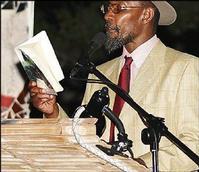
Linton Kwesi Johnson as he read at the Calabash festival earlier this year. Johnson performed at Liberty Hall, Kingston, last Thursday. - CLAUDINE HOUSEN/STAFF PHOTOGRAPHER
A STEADY breeze which fanned poet Linton Kwesi Johnson's words and muted pre-Christmas buzz from King Street, downtown Kingston, did not disturb the quiet audience in Liberty Hall's rooftop amphitheatre last Thursday night.
In addition to the England-based Johnson's reading from his collection published by Penguin, there was a conversation with Professor Carolyn Cooper of the University of the West Indies.
The interaction came after Five Nights of Bleeding, Sonny's Letter, Reggae Fi Dada, Tings An Times and License Fi Kill. Johnson preceded the last by saying it was in response to the term 'ethnic cleansing', saying that it implied 'ethnic pollution'. "It represents an example of the dehumanisation of language and the language of dehumani-sation," he said. "Of course, we now have a new euphemism for kidnapping and torture, extraordinary rendition or something like that," he added, before reading rhythmically:
"De butchers of Kigali mus be sanitary workas ..."
THE ORIGINS OF HIS ART
There was applause when he finished with a "pra pra pram" for the New World Order.
Johnson was joined on stage by Cooper, his jacket, tie and hat and her headwrap and matching dress making a physical contrast.
There was humour right away, as Cooper said; "we have this stereotype in Jamaica that people who go to England come back mad."
"I do not know that Jamaicans who come back here are any madder than any Jamaicans here," Johnson said, to laughter.
Later, Cooper asked about the origins of his art.
"I have always seen what I do as popular culture. I came to poetry through politics," Johnson said, explaining that he was active in the Black Panther movement. He read The Souls of Black Folk by WE DuBois and "it stirred something in me and made me want to express what I was experiencing and what black youths in England were going through ..."
"I was also influenced by what was happening in reggae in Jamaica," he said, mentioning U-Roy, Big Youth and Prince Jazzbo. "I was writing in English and I was moved to write in Jamaican language," he said, noting that in the early 1970s Professor Mervyn Morris encouraged him to write in the latter.
After Cooper asked Johnson about his relationship with other Jamaican poets (he spoke of Edward Baugh, Mutabaruka and Lorna Goodison, saying he was particularly close to Jean 'Binta' Breeze, Mikey Smith and the Poets in Unity from the School of Drama).
He was also definite in his opinion of what a lot of young people are doing poetically. "A lot of young people are writing poetry, but a lot of them don't read," he said. "There is this whole slam poetry thing going around with young people spouting rhetoric about black this, black that. They get away with it by calling it spoken word," he said.
However, Johnson said "there are some young people of promise. I am sure that some great poets will emerge in the next few years. I am not sure if they will be political and they do not need to be," he said.
After the conversation with Cooper, there were a few questions from the general audience, including a request for Top Notch Poet from Mervyn Morris. Johnson read Mikey Smith's Mi Cyaan Believe It, saying that he was going to donate a copy of Smith's collection It A Come to Liberty Hall. And he finished with Top Notch Poet, to strong applause.