Norman Grindley /Deputy Chief Photographer
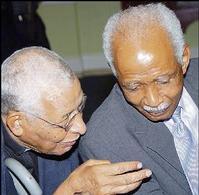
Canon Weevile Gordon (left) Custos of Kingston in discussion with Chief Justice Lensley Wolfe at the recent Ministry of Justice and the Inter-American Development Bank (Citizen Security and Justice programme) awards ceremony.Chief Justice Lensley Wolfe cites the unavailability of witnesses in criminal cases, and the high number of trials by jury as humbugs in the local justice system. But even with these flaws, there is much to be proud of within the existing justice system.
Justice Wolfe was speaking at the Consular Corps of Jamaica's annual banquet held at the Hilton Kingston Hotel on Thursday.
The failure of witnesses to come forward has haunted the courts for many years, as more persons witnessing criminal activities have become fearful for their lives. While the witness protection programme is able to help some, the police have been forced to turn to other kinds of evidence to replace eye-witness reports.
Homicide detectives and laboratory technicians from Jamaica Constabulary Force (JCF) were recently trained in crime scene management by personnel from the United States (U.S.) Federal Bureau of Investigation (FBI). This training included courses in crime scene documentation and preservation of firearms evidence, human remains detection and recovery. The police believe that the development of forensic science will be a critical part of law enforcement in Jamaica.
In addition to the absences of witnesses, Justice Wolfe believes that some cases could pass through the system in a more timely fashion if they were handled by judges and not juries.
difficult to establish juries
He said persons who are sometimes called for jury duties are frequently not in a position to serve, and it is becoming harder to establish juries in some cases and this further slows the already burdened system.
"With the massive increase in crime, we don't have the resources to really deal with the cases as quickly, hence the focus has got to be on reducing crime," he reasoned.
Justice Wolfe admitted that things are not perfect within the courts, but said "to give the impression that nothing is being done to improve the system is mischievous". He points to the fact that local judicial decisions are rarely overturned in higher courts like the Privy Council.
He opined that a successful judiciary has features such as the accessibility to the population, timely delivery of results, high quality of judges and suitable amenities; all of which the Jamaican system possesses.
The soon-to-be completed Portland courthouse, Justice Wolfe said, will be the most advanced of its kind in the Caribbean and plans are afoot for new courthouses to be constructed in Manchester, St. Ann and St. Catherine.
"There is a massive ongoing computerisation programme on all levels of the system. The court reporting system is fully computerised and transcripts are available almost immediately," the chief justice informed.. He also revealed that judges will soon be able to follow the evidence on monitors thus limiting the need for note-taking.
"I have no reason to be ashamed of the administration of justice in Jamaica," he concluded.