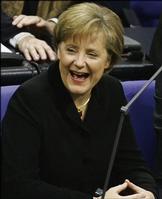
Christian Democrat (CDU) leader and German Chancellor-elect Angela Merkel (centre) laughs after being elected during a parliamentary meeting in Berlin yesterday. Merkel was elected Germany's first woman chancellor yesterday in a parliamentary vote that ends months of political uncertainty and puts her atop a fragile coalition that must prove it can revive the economy. - REUTERS
BERLIN (AP):
ANGELA MERKEL was elected yesterday as Germany's first female chancellor, taking power at the helm of an unwieldy alliance of the right and left that faces the tough job of turning around Europe's biggest economy.
Lawmakers voted 397 to 202 with 12 abstentions to make her Germany's eighth leader since World War II, giving her well more than the 308 votes she needed. She succeeds Gerhard Schroeder, whose seven-year government of Social Democrats and Greens was ousted by voters Sept. 18, and becomes the first German leader from the formerly communist east.
FIRST TO CONGRATULATE
Schroeder was the first to walk over and congratulate a smiling Merkel after the vote was announced.
"Dear Mrs. Merkel, you are the first democratically elected female head of government in Germany," parliament president Norbert Lammert said. "That is a strong signal for women and certainly for some men too. I wish you strength, God's blessing and also some enjoyment in your high office."
Merkel will need all the strength she can muster as her government, made up of politicians who until a few weeks ago were partisan opponents, tackles chronically high unemployment - currently at 11 per cent - and lagging economic growth.
President Horst Koehler officially named Merkel as chancellor later yesterday at Berlin's Charlottenburg palace, ahead of her return to parliament for a swearing-in ceremony.
COMMENT
"Congratulations - I wish you great strength and God's blessing every day," Koehler said.
"Thank you very much, Mr. President," Merkel replied without making further comment.
Tuesday's vote comes six months after Schroeder announced that he was seeking national elections a year early, plunging Germany into political uncertainty, and more than two months after an inconclusive election forced Germany's biggest parties into talks on a so-called 'grand coalition' between Merkel's conservatives and the centre-left Social Democratic Party.
The difficulties that could face the coalition were apparent in the vote, with at least 51 members of the 448-member coalition voting against Merkel in the secret ballot.


















