Dennise Williams, Staff Reporter
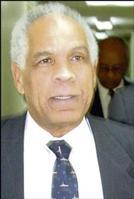

( L - R ) DAVIES AND CHEN
"I MUST admit we were surprised at the number of Jamaicans who buy our sovereign debt," Minister of Finance & Planning, Dr. Omar Davies told the Association of Caribbean Securities Regulators second Annual Conference on Monday at the Jamaica Conference Centre.
If Minister Davies is surprised, the investment community was not. In fact, the following information was provided by Oppenheimer & Company Inc., a New York-based brokerage house that handles a great deal of Jamaican bonds. Greg Fisher, broker at Oppenheimer gave these statistics.
CHART - Jamaican US$ Global Debt
Maturity Date Percentage
Held Locally
2007 high 80%
2011 high 80%
2015 70%
2016 65%
2022 90%
2025 45%
Mr. Fisher notes that in terms of Jamaican Eurobonds, he does not track the numbers.
Dr. Davies went on to say, "We had thought that bonds would be bought mainly by Europeans and North Americans. We really were caught off guard."
The reality is that the international players will buy Jamaican debt, but they don't hold it.
Oliver Chen, vice president of mutual funds at First Global Financial Services explains further.
"Let us take the last three bond issues as examples. Because the Minister (of Finance) didn't want to have run on currency to buy sovereign debt, the Finance Ministry went to international brokers such as Bear Sterns or JP Morgan and told them not to sell to Jamaican companies.
That meant the bonds were then sold to international investors such as European hedge funds. So in the primary offer, say 90 per cent of the bonds are sold overnight to Europeans who took advantage of the time differential. By the time the trading system opened in New York the next morning, these brokers flipped the bonds and created a secondary market where the buyers were mostly Jamaicans.
So what will happen is that the brokerage firms either sell the bonds outright or create repurchase agreements with the Jamaican sovereign bonds as the underlying security. They know that Jamaicans are always willing buyers and that between the next morning and a few months the majority ownership of the debt is in the hands of Jamaicans."
The question then, is why do Jamaicans buy so much of the the sovereign debt?
Clay Moodie, general manager of Dehring Bunting & Golding Unit Trust Managers, says, "Jamaican investors snap up the sovereign debt for two reasons yield and confidence.
Technically, Jamaican debt is below investment grade according to international credit rating agencies. This means that our debt is considered riskier than debt from Barbados and Trinidad & Tobago.
However, the high levels of local participation in the government issue boils back to investor confidence in our economy and future at higher levels than obviously external investors have. Plus, Jamaican debt has some of the higher yields compared to other emerging market bonds like our Caribbean counterparts."
Mr. Chen echoes these sentiments. "The Jamaican Government has never defaulted on repayment because of our heavy net international reserves, so Jamaican investors don't worry about country risk; they more worry about currency risk.
Many Jamaicans who have money hedge their portfolio between Jamaican and U.S. currency."
Acknowledging this fact, Dr. Davies noted, "We have had to make adjustments in the tax structure of the bonds because we thought the bonds would be held by investors in different tax jurisdictions. The 2017 bonds are taxable to Jamaicans at source unlike the other bonds."
But even this has worked to the favour of local investors. Mr. Moodie notes, "Tax free bonds are in demand because local investors can use them to lower their overall tax bill, but the taxable bonds are more liquid because international institutions trade them more often. The taxable bonds have a higher yield and were issued in larger volumes."