Avia Ustanny, Outlook Writer 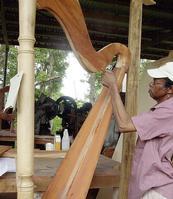
When completed, the column of this harp will be decorated with beautiful wood inlays, carvings and brass. - Ian Allen/Staff Photographer
CLEVELAND BARNETT, son of musical instrument maker Edward Barnett, touched the harmonic curve of a harp with knowing fingers while recently giving us a thorough lesson in what is required to construct the historic instrument. The lesson came during a visit to White River, Ocho Rios, where he was involved in the process of making one of the instruments 'from scratch'.
Said to be the only harp maker in the Caribbean, Barnett has continued his
father's tradition of making unusual use of his woodwork skills, this after retiring from life as a pilot and manufacturer in North America.
His father, a man skilled at his craft, made violins. As related at the website alisonvardy.com, "the harp is the oldest known stringed instrument. The word 'harpa'or 'harp' comes from Anglo-Saxon, Old German, and Old Norse words meaning 'to pluck'. One of the earliest musical instrument discoveries showed a harp-like instrument on rock paintings dating back to 15,000 BC in France. Many believe that the earliest harps came from the sound of the hunter's bow. In Egypt, some of the earliest images of bow harps are from the Pharaoh's tombs dating some 5,000 years ago. These hieroglyphs show that there were many harps in ancient Egypt. The Egyptian Pharaoh Ramses III (1198-1166 BC) had many bow harps painted in his tomb. In the New Kingdom, harps measured up to 2 metres (6.5 feet) in height with 19 strings and were played seated or standing up.
Only one in
the Caribbean
Cleveland Barnett is listed in the publications of the American Harp Society as the only harp maker in the Caribbean. Born and raised in Spanish Town, St. Catherine, he told Outlook that he was always fascinated with the story of King David who played the harp to soothe King Solomon.
He was further intrigued when he saw the instrument for the first time in Canada where he had migrated in the 1970s. There, harp music is well loved. The instruments are played in many restaurants and hotels. It was at the Delta Inn in Western Ontario where Barnett first saw the instrument. He had taken his wife and children there for dinner. He seized the opportunity to question members of the hotel's orchestra about the instrument.
In later years, in a bid to learn more about them, he visited the Lion and Healy company in Chicago where he was accommodated in examining every aspect of the instrument's manufacture. This prompted a further research.
Cleveland Barnett told Outlook: "I researched types of wood in relation to sound. The Jamaican Braselita causes sound to bounce and it is also a tower of strength. Wood of great strength is needed for the harp, which accumulates a tension of thousands of pounds in its strings," he said.
The harp's harmonic curve, when complete, will have 42 strings ranging from E low octave to high.
"We will be boring holes for these. The strings are tight and carry 2,200 pounds of pressure. We therefore, use Jamaica hardwoods for strength," the instrument maker explained.
The choice of wood include mahogany and braselita, another strong wood, which is used in railroad ties. Other companies in the United States use metal, but Barnett discovered that the Jamaican wood was strong enough.
Polished brass
The post, or the upright column of the harp which stands 90 degrees from the ground, is usually decorated with polished brass, inlays of purple heart and hand carvings.
During the construction process, the harp maker will also calculate a centre of buoyancy in the harp. This ensures that, when placed down, it balances and when tilted for playing, the harp should only weigh five pounds.
The player will strum the harp while sitting on a high stool behind the instrument, tilting the soundboard towards him or herself. The bass strings are played with the left hand and the treble with the right.
The tuning, strings, string posts, sharper and other elements of the harp construction are done by other companies when Cleveland Barnett completes the main structure.
So beautiful are harps when finished that they are frequently used as the decorating focal point in residences.
There is a consistent market for the pieces made by Cleveland Barnett who can manufacture a harp in a few weeks. He plans to turn out several dozen in the new year.


















