Earl Moxam, Senior Gleaner Writer 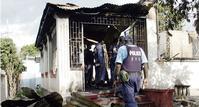
THE BRUTAL death of ten-year-old Sasha-Kaye Brown and members of her family in their Barnes Avenue home a month ago has reignited the desire of Rear Admiral Hardley Lewin, Chief of Staff of the Jamaica Defence Force (JDF), for limited policing powers for his men.
The conscience of the JDF and nation at large was seared by eyewitness reports of the cries for help from Sasha-Kaye Brown, as the flames lapped at her frail body while the gunmen stood by preventing the neighbours from rushing to her aid. And soldiers nearby did not respond to urgent calls for help.
UNCOMFORTABLY CONSTRAINED
According to the Chief of Staff, soldiers are uncomfortably constrained by the requirement that they must perform certain policing duties only if accompanied by members of the police force.
It was for that reason, he emphasised, in an interview with The Sunday Gleaner, that the JDF had supported proposed legislation, which would have seen soldiers being empowered to act on their own in certain specific situations, having the full powers of a constable.
The proposal was that Section 9 (3) of the Defence Act would have been amended, granting the JDF troops power to "search, apprehend and detain" on their own. Those persons detained would be handed over to the police as soon as
possible thereafter.
That proposal was rejected by the select committee of Parliament, which considered the matter, principally because of fears that the military would be getting involved in a level of policing activities for which its members were not trained, resulting in the use of excessive force and the abuse of citizens' rights.
The debate was reignited by the October 5 Barnes Avenue massacre.
Sadness at the death of Sasha-Kaye, her grandmother, Dorcas Brown, her grandfather, Gerald, and her aunt, Michelle, was tinged with outrage, in light of reports that residents sought assistance from a group of soldiers posted nearby, but were told by the military men that they could not respond on their own; they could only do so in the company of the police.
As this reporter sat with Rear Admiral Lewin at his Up Park Camp office, he leafed grimly through a bulky file of newspaper clippings, many of them reflecting that outrage at the JDF.
While acknowledging that the soldiers hesitated "for 10-15 minutes", because of the operational constraints that they were under, he asserted that they did respond "because they were, in fact, the first agency on the scene, with the fire service arriving almost simultaneously and the police some minutes afterwards".
"So, what transpired during that 10-15 minute period of hesitation?" I asked.
CONTEMPLATING THEIR OPTIONS
The soldiers, he said, were left contemplating their options in light of their legal constraints, before deciding to "take a chance" and go to the scene. By then, tragically, it was too late. Sasha Kaye's screams had already been silenced by the unrelenting blaze.
According to the Chief of Staff, trapped between their legal constraints and their conscience, soldiers, in such situations, will always be faced with a dilemma: In one scenario in which they respond without hesitation and, in an exchange of gunfire with gunmen, kill the lawbreakers, there might be no controversy. In another scenario, however, he worries about public reactions where the operation does not go as smoothly and, perhaps no gun is recovered or, worse yet, civilians are killed.
"The first question that people are going to be asking is why were you there without the police; that was not how you were meant to operate? What was the legal basis for you to be out there on your own?"
While insisting that he was not restarting a campaign to secure the legislative changes proposed to the Joint Select Committee of Parliament a year ago, Rear Admiral Lewin asserted that the existing situation was untenable.
SOLDIERS IN A DILEMMA
In his presentation to the parliamentary committee, the Chief of Staff had argued along similar lines. He said then that where the JDF was deployed on operations pursuant to section 9 (2) of the Defence Act, situations often arose when a policeman was not available to carry out the functions of apprehension, detention and search. He told the committee that in such circumstances the soldier was placed in a dilemma: any action taken other than in self defence would be in breach of the law; while taking no action would be defeating the purpose for which he was deployed in the first place.
Ultimately, he argued then, the deployment of the JDF under the existing legislative sanction did not represent a true 'force multiplier' since "the ground commander is then forced to adopt tactics based on the configuration of his personnel (JDF v JCF) rather than upon the situation".
In response then to public concerns, the JDF amended its proposal to parliament, asking for the additional powers to be granted to the military to operate on its own only in respect of those offences committed under the Firearms Act.
It was nevertheless rejected.