Royson James, City Columnist
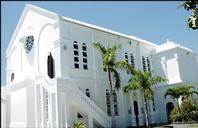
The synagogue of the United Congregation of Israelites on Duke Street, downtown Kingston. - PHOTOS BY ANDREW SMITH/PHOTOGRAPHY EDITOR
KINGSTON, Jamaica:
"I WANTED something special, different," Daniel explains in the expansive lobby of the Sunset Jamaica Grande in Ocho Rios, days before the religious ceremony marking the 13-year-old's passage into manhood. "I didn't want a dance party. I wanted to go NASCAR racing."
He got Jamaica, instead, a place where NASCAR driving skills come in handy in negotiating hairpin curves on pothole-sensitive roads. And a place that's home to an impressive but little-known Jewish history.
Last Saturday was a day of celebration at the Shaare Shalom Synagogue on Duke Street in Kingston, the last of the synagogues that once dotted the island.
It was Daniel's birthday; 35 years (within five days) since his dad left Jamaica as a child for Canada; the 40th anniversary of his cousin Victor's own bar mitzvah in the same synagogue; and 350 years since Portuguese Jewish refugees fleeing the Spanish Inquisition were allowed to worship freely in this island paradise.
And it all came together in a moving ceremony before 80 synagogue members, relatives and friends, aged 11 to 90, from as far away as Vancouver and Atlanta, Ga.
A RICH AND FRUITFUL HERITAGE
Erected in 1921, this was once a place where "everybody who was anybody" among Jews in Kingston met and worshipped. It's here that Daniel's dad and aunt Julie first heard the holy passages from the Torah. It's here grandma Veta and late grandpa Herbert repeated scriptures and sang hymns. And it's here that Daniel now stands to embark on this life cycle event - at what has become the island's sole repository of a rich and fruitful heritage.
"O my God and God of my forefathers. On this solemn and sacred day, which marketh my passage from boyhood to manhood ..." Daniel says, repeating the rare bar mitzvah prayer not found in Toronto synagogues.
"Only in Jamaica do you pledge to be a good Jew and say your prayers," his father had said earlier. "Absolutely perplexing, but meaningful."
Daniel stands in front of an enormous two-storey mahogany Ark of the Covenant. It cradles 13 Torahs, exquisitely wrapped and covered. One is removed and passed from father to son. The boy pledges to observe God's "holy law and those precepts on which human happiness and eternal life depend," his voice rising above the whirr of 17 electric fans.
To his left, relatives hang on to every word; to his right, are guests, including the Governor-General of Jamaica, Sir Howard Cooke. Straight ahead is the tebah or altar. And in between, a most wondrous thing: the floor of the synagogue is all sand.
(Sephardic Jews of Portuguese and Spanish background who first settled in Jamaica were used to worshipping in secret to avoid persecution. They often covered the worship place with sand to muffle the sound, hide footprints and make detection more difficult. Later, they used it in their synagogues).
The kiddush, following the service, features guests chewing on sugar cane and an assortment of tropical treats. The Queen sent her regrets, but the Governor-General was a welcome stand-in, bringing "royal recognition."
"The Jews themselves have done a magnificent job for this country and every time I get the opportunity I want them to know that I respect what they've done, I appreciate what they've done," Sir Howard tells the Toronto Star, adding that if the community can attract Israelis from the Middle East, Jamaica would welcome them.
It wouldn't be the first time.
Ainsley Henriques, the resident historian, raconteur, synagogue leader, consul general for the Israeli government and chair of major organisations like the Jamaica National Heritage Trust, aims to preserve the Jewish story in a museum, interpretative centre, and memorial gardens, next to the synagogue.
HISTORY OF THE JAMAICAN JEWS
He says the first Jewish settlers arrived from Spain and Portugal between 1494 and 1655, when the island was under Spanish rule. It wasn't safe to be a Jew. This was the era of the Spanish Inquisition. People were burned at the stake for not adhering to Christianity. To survive, many Jews hid their identity and worshipped in secret.
But the British captured the island in 1655 and a flood of Jews followed.
By then, Kingston was the seventh largest harbour in the world and the notorious Port Royal was known for its pirates and gold and iniquity.
An earthquake destroyed Port Royal in 1692 and many Jews resettled in nearby Spanish Town and erected a "synagogue, probably the fourth oldest synagogue site in the Western world, around 1704," Henriques says.
They traded in pimento, cocoa and other crops. And when the new subdivisions in Kingston opened up, many flocked there to pursue mercantile trade and other businesses. "In all, there are some 21 Jewish cemetery sites on the island," he says.
When the Sephardic Jews joined with the Ashkenazis and formed this congregation in 1921, this was an important place for an important people. The Titans of commercial life in Jamaica came here to pray, with names like Matalon and Ashenheim and Henriques and deCordova, Barrow and deSouza. Controversial Black Muslim leader Louis Farrakhan worshipped here.
This day, even counting the boost from Daniel's bar mitzvah crowd, the numbers are not nearly enough to fill the many empty chairs.
There used to be some 400 Jewish families in Jamaica. Now there may be 30. And the clock is ticking on a community that has given the island judges and lawyers and mayors and builders and money changers and architects and members of parliament and cricketers and farmers and yes, even the odd slave owner.
"It's important to the Jamaican people, to the Jewish people to know we left a legacy, even if we disappear," Henriques says.
Such talk troubles Charles Hendricks, Daniel's dad. "I would be disappointed to see that community disappear," he says.
For the past two years, Charles planned every detail of the bar mitzvah in Jamaica. Driven by a passion to show off Jamaica, to share his heritage with his son, and focus on the island's Jewish history, Charles pursued the idea with unwavering devotion.
And when Daniel completed his Torah reading with class and precision, the proud papa was a flood of emotions.
"Not bad, eh," Charles grinned. "It went even better than I had anticipated."
It was 1970 that his mom Veta and dad Herbert took Charles, 11, and sister Julie, 4, from the sun and sand of Jamaica to seek a better life in the slush and snow of the Great White North. Not that their middle-class existence was especially distressing.
Herbert Hendriks had been a long-serving civil servant, had ascended to clerk of the courts and was well connected. But he was 78. And the much younger Veta pushed for the move. Things were changing in Jamaica. Michael Manley was pushing a more nationalistic agenda. The flight of the middle class was beginning. Veta wanted out.
"They had to literally drag my dad onto the plane," Charles recalls.
Now, 35 years later, Charles and his family are back. "I've always liked the island; I've always liked its people," says the marketing executive.
For 16 days the family and friends played tourists. They rafted on the Rio Grande, climbed Dunn's River Falls, drove through Fern Gulley and out to Port Royal, journeyed to Negril for parasailing, and trekked to Port Antonio, with stops in Ocho Rios and Montego Bay.
Daniel fell in love with sugar cane and the Jamaican thirst-quenching drink, Ting. His sister, Kayla, lived in the pool and on the beach.
They didn't want the commercialised, dressed to the hilt, overblown party and bar mitzvah celebrations they'd seen so often in Canada. "This was special," Daniel said.
One's left with the image of a family scattered by circumstance but called together in a sacred place, to witness and mark the coming of age of a child, in an ancient synagogue in an adopted birthplace so different and so familiar.
"My son, do not forget my teaching ..." Daniel's mother, Laurie, reads from Proverbs. "Bind them about your throat, write them on the tablet of your mind, and you will find favour and approbation in the eyes of God and man."
Daniel stands in the sand, facing the ark, alone, absorbing the words, white dust all over him.
"Fear the Lord and shun evil. It will be a cure for your body, a tonic for your bones ..."
Charles is weeping.
"I haven't cried since David (his 11-year-old) was born," he says later. "I was just blown away by it all.
"I wanted to do what I could to lend some clarity to the true Jamaican image and spirit, which is not what we see and hear in Canada. It's a cultural and religious history summed up in the country's motto, Out of Many One People. I think we accomplished that in spades."
The branches of the Cuban palm trees bend in the breeze as the children - Daniel, Kayla, David and cousins Hailey and Jordan ascend the altar to lead out in the singing of the hymn, Ayn Kay-lohaynoo, "There is none like our God." It's 32 degrees in the shade of the noonday sun as the melody climbs the lofty columns of the immaculately white synagogue.
Spiritual leader Stephen Henriques has prayed for the government, for Israel, and the new month. And even as sirens wail outside, portent of some urban ill in a teeming city, the congregants stand and sing with pride and vigour: "Eternal father bless our land, guard us with thy mighty hand ... Jamaica, Jamaica, Jamaica land we love."
Taken from the September 10 edition of the Toronto Star. Reprinted with permission - Torstar Syndication Services.