Laura Tanna, Contributor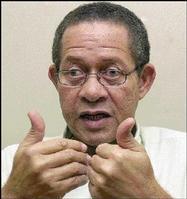
GOLDING
WHEN I first interviewed Orett Bruce Golding in 1982, he was Minister of Construction.
We discussed topics such as the disappearance of hundreds of Cuban-trained Brigadistas' files from the Ministry just after the PNP lost the 1980 election.
This time, I asked Golding to speak about himself his formative years. Until this interview on August 30, I'd never realised that the most profound influence on him was his father, former Speaker of the House of Representatives, Tacius Nathaniel Golding.
Born in 1900 and a graduate of Mico Teacher's College, Tacius Golding became headmaster of the Macca Tree Clarendon Primary School within his first year and remained there for 16 years.
An educator with an outstanding record of student passes, the elder Golding married at age 43 to a graduate of Shortwood Teachers' College, Enid Louise Bent, a teacher 20 years his junior whom he met after moving to become head of a school in Ginger Ridge, St. Catherine, on the border with Clarendon.
Their first son Trevor, born in 1944, is a doctor. Their daughter died shortly after birth in 1946 and the politician we know as Bruce was born in 1947, followed by a younger son Tony, who became a banker.
Tacius Golding taught for eight years at Ginger Ridge and in 1949 was elected Member of Parliament for South-West St. Catherine.
Though born in Ginger Ridge, Bruce remembers growing up in Macca Tree with neither running water nor electricity.
NO WATER OR ELECTRICITY
He describes those early days: "We had tanks at the back and fetched water to bring it into the house. Every bedroom had a washstand, a big enamelled basin and what we called a goblet, and an outside toilet. That's how we grew up. When I was seven, my mother got a post at Alpha Academy, which required her to move to Kingston. So my father bought a house in town and put us all here. He stayed in the country, close to his constituency. Whenever he came in for Parliament, he would stay over and the moment Parliament was over, he headed back, so we maintained two households. We did that for most of our lives.
"We lived in Kingston for four and a half years and then the strain of maintaining two households began to take its toll. So my parents decided to build a house mid-way between, in Old Harbour, in 1959. That was still in his constituency and Mother would drive to Kingston everyday, drop us at school and then go to teach. That's how I got to Alpha Primary School, because it was convenient for her."
In explaining his choice of a political career, Golding says: "For reasons that I don't really know, I was always very close to my dad. Closer than the other two kids. I was sort of his favourite, and I always liked riding around with him. He had an old Hillman Hunter and wherever he was going, I would insist on going with him and would cry if he didn't let me. From I was about eight years old he started taking me to political meetings at night, which upset the hell out of my mother because we were coming back at 12 o'clock, one o'clock. When my mom really put her foot down and insisted that I not go, I would hide in the back of the car but he wouldn't be aware. If I surfaced too early, he would turn back and drop me home so I'd wait until he was miles and miles away and then I'd just touch him on the shoulder and say: "Hey, you've got me here."
"Then I started to make myself useful. By the time I was about 10, he had these old public address systems, where the amplifier was big and weighed a ton. The microphone had wires all over the place and started breaking down at the meetings. I watched what got it going so that the next time I would know exactly what to do. I was fixing the microphone whenever it broke down and setting it up, until I became indispensable.
"I worked with him at his office during school holidays. I learned to type from I was nearly 11 or 12. So I would type all his letters for him. When he was going out to the constituency, he would leave home right after breakfast and he goes the whole day, from village to village, dealing with the kind of routine things that people complain about farm work programme that they want to get on; farmers who need assistance from the Ministry of Agriculture that kind of stuff. He goes around with his big book and he writes it down until I started writing down the stuff for him."
EDUCATION
Perhaps this early association with older people led the young Golding to a certain precociousness. It was no accident that he attended St. George's. He says when taking his Common Entrance exam in 1956, he gained 345 points. Three hundred was considered a passing mark but because he was young, school authorities decided he could stay at Alpha Primary School another year and a higher school place could go to someone older.
Nine-year-old Golding went to the headmaster of St. George's and presented the case that having achieved the marks he had, he should not be discriminated against because of his age.
Though Father Donahue had not met him before, he agreed and allowed him a first form place if his parents would pay tuition.
Young Golding then informed his astonished parents.
The following year he took Common Entrance exam again and from second form on relieved his