- File
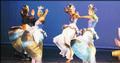
A scene from the NDTC's Season of Dance.
Brian Heap, Contributor
THE NATIONAL Dance Theatre Company of Jamaica's 2004 Season of Dance has proven to be something of a watershed season. None of us adapts that easily to change.
In fact, for most people there is an immediate gut reaction which kicks in to resist change of any kind (frequently these days by blocking a major road). We become so comfortable with things as they are, that even when faced with a clearly progressive move, our attitude frequently hardens into intransigence.
Why does there have to be change? Well, change is an integral part of life, and as a species we either end up suffering it, tolerating it or celebrating it. Fortunately, the NDTC chose to celebrate life's inevitable changes in its recently concluded season, but in its own characteristic way.
Clearly on the stage we see a new generation of dancers going through their paces, and if we can put the inevitable nostalgia for the 'old' NDTC on hold for a moment, we might just be able to see that these days the company is represented by a very high level of accomplishment in dance, choreography, as well as design. It always pays to revisit the NDTC throughout its season, if for no other reason than to pay close and careful attention to what this internationally acclaimed group is really doing.
The established programme opener Drumscore provided a good example of what the NDTC is experiencing in its transition to a more youthful phase of its existence. The young dancers, supported by the NDTC drummers and singers, continue to be conducted from the orchestra pit by the assured hand (and voice) of musical director Marjorie Whylie, in the execution of this solid artistic statement from master choreographer and NDTC artistic director, Rex Nettleford. So the 'older' hands guiding the young are never far away.
EXUBERANCE AND FREEDOM
It was interesting to see in the course of the season how the tentative and somewhat academic opening night performance of this work, subsequently gave way to the exuberance and freedom required of this work. By closing night it was a joy to behold.
Even where the presence of the guiding hands is not immediately apparent, as with the outstanding and innovative choreography of Christopher Walker's Urban Fissure and Fragile, it takes no great stretch of the imagination to relate these to works from the earlier NDTC repertoire.
Walker's post-modern approach in Urban Fissure, with its introduction danced against a wall of silence, and sharply bent-knee leg lifts held for inordinately long periods, incorporated with street-smart stepping and facial expressions numbed by their encounter with violence, produces what is tantamount to a challenge to the established Caribbean dance vocabulary.
DANCE MASTER NETTLEFORD
The result is really a Street People for our times, so that even if the literal hand of dance master Nettleford is not overtly apparent, the aesthetic legacy certainly is. Walker, himself a product of the NDTC-founded Jamaica School of Dance, may not even be consciously aware of the influences, but for this detached observer his dance Fragile similarly resonates with key elements of Nettleford's The Crossing, albeit within a totally new and original dimension of form and vocabulary.
This NDTC season of transition saw other young choreographers honing their skills, most notably Keith Fagan's solo, aptly named In Transit, danced with consummate physical grace and skill by Marlon Simms, yet another of the company's emerging dance scholars. Outstanding, however, was the choreography of Arsenio Andrade in Dimensions, a work of breathtaking simplicity and beauty which deserves to hold its place in the repertoire for many seasons to come.
Beginning in Part One with an exquisitely staged pas de deux, demonstrating a combination of acrobatic contortions and control reminiscent of the Pilobolus Dance Company, the work gives way to a second movement for six dancers who move from simple variations of walking to the most fluid, organic patterns of inter-connecting bodies.
Perhaps the most significant bridge between the 'old' NDTC and the 'new' resides in the choreography of Arlene Richards who takes as her inspiration the myth of Oedipus for one work and the Caribbean people for another entitled Azure.
The latter work is the more successful of the two, and represents perhaps her most mature and assured choreography to date. A beautifully costumed corps de ballet (and her Richards takes the design honours too) moves through what is almost a concerto form of three movements to music from the Afro-Celt Sound System.
The facts of her exclusive in-company training as well as her exploration of the Caribbean dance vocabulary both serve to mark Richards as a keystone in the arch that connects the present company with the past.
OLD WORKS
Finally, there are the old works, revivals of Rex Nettleford's The King Must Die and Pocomania, as well as Clive Thompson's Diva (although his Folktales must be considered a relatively recent creation).
These challenge the young company to come to grips with works and their accompanying dance vocabulary, which have shifted into the realm of company classics. On opening night the young dancers had to contend with the distorted music for The King Must Die, but with its soundtrack restored to pristine digital clarity, they were able to interpret the work with a heightened level of intelligence at the season's close.
The re-staging of works is never a straightforward matter, if for no other reason than they evoke memories of so many past members of the NDTC who have skilfully created and established these roles.
One calls to mind performances by the likes of Melanie Graham, Milton Sterling, Yvonne DaCosta, Barry Moncrieffe, Barbara Requa and a host of others. But in dance, as in any other sphere of life, the challenge to the young generation is to take up the gauntlet and establish a clear and new ownership of the work, while the old guard by turn gives its encouragement, criticism, wisdom and loving support as needed.
Change is never easy, but once we generously recognise its necessity and embrace it, anything is possible.