- Howard Moo Young
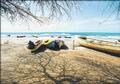
TREASURE BEACH a wide-angle lens was used to capture this scene, carefully placing the horizon line in the top third of the image with the boats converging toward the centre. It was important to emphasise the shadows caused by the overhanging branches.
Howard Moo Young, Contributor
THE COMPOSITION of a photograph has a powerful influence on how the viewer interprets the picture. Most people are emotionally moved by the subject matter of a picture, and to some degree they can feel sad, such as a photograph of dying AIDS patients, or a joyful picture of Veronica Campbell winning the 200 metres at the 2004 Olympics. How many of them realise that the composition of the photograph subliminally influences the message that the photographer is delivering?
THINKING COMPOSITION
The traditional rules of composition were passed down to us by painters, who also taught us how to light their subjects. We can all learn from the masters. These artists could not visualise a landscape painting as seen through the wide-angle or telephoto lens, but with the advent of the camera, photographers could now apply the rules of composition and even manipulate perspective, as they viewed their pictures within a given frame.
Compositional awareness is what ultimately separates an average photographer from a very good one. It's the ability to compose your photographs so well, that the feeling you capture about a subject, you'll pass on that feeling to the viewer.
THE LAW OF THIRDS
Divide your frame into thirds both vertically and horizontally. The law of thirds states that the four points where the lines intersect are the strongest points in which to place the most important feature of your photograph.
THE GOLDEN TRIANGLE
The use of the golden triangle is mostly used in the composition of portraits. The triangle is a powerful form and can be placed anywhere in the frame. It's a very strong, tried and tested compositional form.
PHOTOGRAPHIC COMPOSITION
Once you take a look through your viewfinder, try to manage the allotted space in placing the subject, so as to tell the story as effectively as you can. Many photographs we see are not necessarily grab shots but, in fact, very well planned. You have to learn to make compositions in the viewfinder, sometimes leaving space for a figure, such as a passenger disembarking from a crowded bus, or anticipating a cyclist to fill a spot in the picture. Try composing and waiting for the decisive moment, see if it works. You can also direct someone into your allotted space, if you prearrange it.
During the learning process, there may be some compositions that don't work very well, but keep trying, and very soon you will develop your own style. Try being different and be bold about it! Always decide if the image fits better in a horizontal or vertical format, or use the opportunity to do both, remembering that a change of lens can sometimes solve the problem.
PATTERNS
Check out for patterns around you. You can isolate these to make exciting pictures. Look for shapes and colour changes, and their overall effect on the composition.
CREATE VISUAL EFFECTS
There's a whole host of options available to you once you've learned the rules of composition, you'll start looking for patterns and leaving space in your pictures.
ELIMINATING SPACE FOR A REASON
By cropping right in on the head in a portrait and eliminating all space around the person, you can create a totally different feeling. The person's face is almost trapped within the edges of the frame, giving a claustrophobic feeling. Try this out for yourself by shooting a few frames like this, and others, where you leave space around the face.
Talking about space, the recent visit of Hurricane Ivan to our island completely changed our environment, allowing lots of space around us, all in a matter of 24 hours. As I looked at the fallen trees all over the terrain and felt the cool, clean, damp mountain air descending on my back patio, I suddenly realised that there was much more breathing space, 360 degrees.
PHOTOJOURNALISM OPPORTUNITY
'Ivan' presented the perfect photographic opportunity island- wide, and it didn't matter what kind of camera or film was used to record the destruction. Indeed, almost every photographer became a photojournalist.
The wind took its toll on banana plantations, roofs, gardens, billboards, signs and light poles. The torrential rains totally flooded out valleys, farms, gullies, changed courses of rivers, washed away homes, drowned humans and thousands of livestock.
The combination of both wind and ocean caused giant storm surges that destroyed shorelines, while many houses disappeared completely. Photography played an important part in visually telling the story of 'Ivan' with images of impact. Our daily newspapers published many graphic images that were full of impact. This column would like to commend all the contributing photographers who put their lives and equipment in danger to capture these compelling pictures that attracted and held the viewer's eye. It's so important to have a camera with you at all times. Just think of it, hurricanes give warnings, earthquakes don't.
THANKS
As this is the first article I have written in more than three months, I would like to take this opportunity to thank all of you who supported me with your messages of comfort and encouragement, following the recent passing of my dear wife, with whom I shared the joy of photography.
It was through this medium that we met, and my next photographic exhibition, which is going to be an exclusive selection of unusual images, taken over the past two years, will be dedicated to her memory.
Howard Moo Young is an advertising/graphic design/photography consultant with over 40 years experience. Email: mooimages@yahoo.com