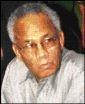
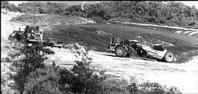
From left are Dr. Carlton Davis. At right, bBauxite mining operations in Blenheim Town, Manchester. -File photos
Earl Moxam, Senior Gleaner Writer
EVEN AS the country prepares to embark on the most significant investment in the bauxite/ alumina industry for many years, one respected expert is warning that time is running out for the industry, with a limited amount of bauxite left to be exploited.
"What we are dealing with, given the enhanced production that we are contemplating, is the last 50 years of an industry based on local reserves," said Dr. Carlton Davis, chairman of the Jamaica Bauxite Institute (JBI), in an interview with The Sunday Gleaner.
Dr. Davis estimates that the existing reserves of bauxite ore to be about 700 million tons, just under half of the 1.5 billion tons of reserves estimated at the time of the Bauxite Levy negotiations in 1974. Earlier this year Alcoa announced its decision to double the capacity of its Jamalco plant at Hayes, Clarendon, to 2.7 million tons, with an investment of just under US$690 million.
Smaller expansions are also being undertaken or are being planned for the other alumina plants which, while increasing earnings from the sector in the short term, will speed up the rate at which the reserves are depleted.
"There is one more possibility for a substantial new investment in an alumina plant, and that's at Lynford in St. Ann where the Reynolds Bauxite plant once operated. But there are issues, not least of which is the fact that Ocho Rios, located nearby, is now a busy tourist town," Dr. Davis said. "It can be managed, but it could be controversial. The odds therefore are that, as far as expansion in the plant capacity is concerned, we're looking at the Jamalco upgrade to 2.7 million tons, Alpart at two million, and Windalco, potentially going up by another 500,000 tons, making it 1.8 million, and that would be it."
SEE FULL STORY IN
TOMORROW'S GLEANER
little intro and run with this story from A1
start here
In 1974 the Jamaican Government unilaterally imposed the controversial Bauxite Levy, which saw the country's revenue intake from the industry immediately jumping from US$23 million per annum, to more than $US200 million per annum.
Dr. Davis estimates that over the period 1974 to 2002 the country earned US$3.5 billion from the industry, most of which went into the Capital Development Fund (CDF).
The CDF was established in 1974 as a vehicle through which earnings from the Levy would be invested in sustainable projects, thereby securing long-term benefits for the country from the industry.
In a frank admission, however, Dr. Davis, who is also the Cabinet Secretary, conceded that the bauxite revenues have not always been spent as wisely as they could have been, with regular withdrawals being made for budgetary support and recurrent spending.
"The CDF has never been effectively operated. It was set up as a pool of money separate from the Consolidated Fund, but the legislation made it too easy for Government to have access to it. The truth is, we have never, as a country, come to terms with how we finance our recurrent needs without resorting too much to those things that we said should give us the cushion to deal with serious emergencies, and to deal with development. We've really not done what we ought to have done with those bauxite earnings, apart from a few exceptions," he argued.
In contrast, he said, Trinidad and Tobago has generally utilised its oil revenues in a more prudent manner.
Asked to explain the differences in approach, Dr. Davis suggested that the continuity in policies guaranteed by the 30 year dominance of the People's National Movement (PNM) government of Dr. Eric Williams in that country was a major factor.
"They never had to resort to the politics of populism in the way that we have had to, because there was no period in which there was any guarantee which of our two major parties would win. And I believe it has led us sometimes, maybe inadvertently, to seek the path of least resistance," he said.
Two years ago the Government embarked on a phased abandonment of the Bauxite Levy, which is being replaced by an income tax regime, with incentives built in for the companies to invest more in the industry.
Industry sources point to that agreement as the major factor behind Alcoa's decision to invest heavily in the expansion of the Jamalco plant. It is expected that the CDF will eventually be eclipsed under the new fiscal arrangement.
Nevertheless, Dr. Davis remains optimistic that the money to be earned from the remaining reserves will be more prudently utilised.
This, according to him, has begun, with some of the funds being used as equity in some hotel projects and in community development projects, in those areas close to bauxite operations.
Asked to suggest the areas in which future bauxite revenues should be utilised, Dr. Davis listed Education (particularly Information Technology and specialty areas such as Accounting), skills training, sustainable tourism projects, targeted irrigation projects, high-value crops, and fisheries.
"If its one of the last things I would like to do is to bring the Fisheries Department up to the level of an Executive Agency, and give it the sort of status and calibre of the JBI (Jamaica Bauxite Institute). Because our marine environment is several times larger than our land environment and this represents a huge resource that we're taking for granted. If we could strengthen it, institutionally, and give it the capacity to go beyond our current limited utilisation of these resources, then, frankly, bauxite won't be missed," he predicted.
But Dr. Davis' vision for the bauxite/ alumina sector does not quite end with the 50-year timeline.
He is predicting that, with its plant capacity and expertise, plus its ideal location along the transshipment route, the major companies will still want to import bauxite ore from countries such as Brazil, Suriname and Guyana for processing in the Jamaican alumina plants.
Until then, he is calling for the lessons of the past to guide prudent choices for the future.