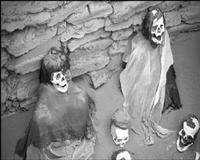

At left, perhaps both the living and the dead could be accommodated on the disputed Llandilo site in Westmoreland.
At right is Glenda Simms
Glenda Simms
AS A Western Jamaican nationalist, I always look forward to the Cornwall Edition in the Gleaner. The recent article by Cedric Johnson entitled, 'Give us the dead, not the squatters', which was carried in the May 13, 2004 edition was of particular interest.
After perusing the content and finding myself preoccupied with the idea that some Jamaicans are much more comfortable with the dead than with 'some of the living', it occurred to me that perhaps both the living and the dead could be accommodated on the disputed Llandilo site in Westmoreland.
My idea is not original, but it is based on my personal experience, when in the mid-90s, I was afforded the opportunity to study management practices and the impact of these on women in a number of countries. On a visit to Egypt I was informed about the status of women by both secular and religious men who held power in most of the institutions with which I interacted. Inspite of this 'masculine wall', I was able to visit with a female-headed household who lived in a cemetery the famous 'City of the Dead' in Cairo.
'CITY OF THE DEAD'
A search of the Internet will inform readers that "on the eastern side of Cairo, there is an immense cemetery known to foreigners as the 'City of the Dead'." To the average Egyptian, this place is simply a cemetery, "an active city-like grid with a wild labyrinth of tombs, pantheons and mausoleums".
In this cemetery, nearly one million poor and homeless Egyptians live and survive. In harmony with the spirits of their ancestors, they cook, wash, clean, make love and give birth to children, some of whom manage to get educated to a level where they can afford to change their address.
Like in many other countries, some of the homeless people who "squat" in the tombs in Cairo, are folks who fled crowded and violent ghettos and others are those who have drifted from rural areas to follow the lure of bright city lights and the hope of finding jobs and prosperity in the urban centres.
As the economic and social situation deteriorated in Egypt, more and more poor women, men and their children became homeless. It is these poor and landless folk who are forced by circumstances to take up residence in the famous 'City of the Dead' in Cairo. These disenfranchised Egyptians occupy the stylish little houses and the elaborate monuments which were designed to house the last remains and spirits of rich folks.
'TOMB HOUSES'
I consider myself privileged when I visited with a female-headed family in one of those 'tomb houses'. I was shown the conditions under which poor people survive. I learnt that some of the cemetery occupants pay a small rental fee for the use of the facility. Of course, the rent collector was not necessarily connected to or known by the family who owns the tomb. Some other occupants were allowed by tomb owners to pay their keep by keeping their surroundings clean and presentable.
In a real sense, the 'City of the Dead' has become an important feature of the Cairo socio-political landscape, and tourists and other visitors regularly take photographs and do documentaries not only on the cemetery dwellers, but also on the ornate and unique artefacts that are in many of these old monuments.
TOMB
The woman who invited me into her tomb, lived with her daughter and her grandchild. She was very forthright and informed me that the family which owns her particular tomb still bring their dead relatives and bury them in the chambers below the 'little house'.
I have no idea whether such living arrangements could solve the housing crisis of the squatters who now occupy the Llandilo property which was originally earmarked by the Westmoreland Parish Council for a cemetery.
According to Cedric Johnson, the good folks of Llandilo "were uncomfortable with having a cemetery so close to their homes". At the same time, they do not want squatters on the cemetery site".
Perhaps in this contradiction, the 'City of the Dead' in Cairo could serve as a model of how we could accommodate both the living and the dead in situations where the need for a cemetery is in competition with the imperative to house the homeless.
Some Jamaicans might not consider this a 'crackpot idea'. After all, we Jamaicans are very adaptable and we have an insatiable appetite to consume foreign goods, services and ideas. Also some of us know that we were once kings and princes and sometimes princesses. We know that ancient Egypt, in all its glory, is part of our African heritage. But Egypt is more than the Sphinx, the pyramids, the Nile Valley and the hieroglyphics. Egypt also has its 'City of the Dead'.
Perhaps this model of the living and the dead in harmony could be piloted in Llandilo. If successful it would accomplish two goals. Firstly, it would house the destitute and the homeless, and secondly it would show to all and sundry that we should not be afraid of our ancestral spirits.
'In short, we might yet become a nation of 'duppy conquerors'. In such a nation, some powerful myths would be destroyed. Once we 'conquer duppies', we would stop believing that "sex with virgins cure sexually transmitted diseases", and "if man don't beat mi im nuh love mi".
Also, those who are committed to 'making duppies' would soon learn that it is pointless making something that no one is afraid of. In the final analysis, it might be better to be 'duppy conquerors' rather than 'bull
buckers'.
Glenda P. Simmsis the
executive director Bureau of Women's Affairs.


















