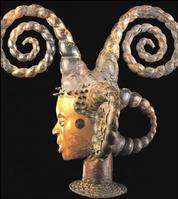
Ejagham Dance Helmet from Ekoi, Nigeria, an illustration in the University of Technology's catalogue of the video archive at the Calvin McKain Library.
-Contributed photo
Cedric Wilson, Contributor
Earlier this year, the University of Technology (UTech) formally celebrated the opening of the art and architecture video archive with a weeklong film festival and the publication of the catalogue.
The video archive at the Calvin McKain Library at the university is home to an impressive collection of almost 700 films and video clips on art and architecture, with an emphasis on Caribbean and African material.
The archive is the brainchild of Ann Buttrick, a Canadian artist who, while she worked briefly at the Edna Manley College for the Visual and Performing Arts (EMCVPA) in 1991, was struck by the paucity of video material available on Caribbean art despite the aesthetic richness of the region.
In 1995, Mrs. Buttrick returned to the island and found an enthusiastic sponsor in Dr. Alfred Sangster, who was president of the university at the time. Dr. Rae Davis who succeeded Dr. Sangster gave the project his wholehearted support and today, nine years later, the university and the region are richer as a result.
EXCELLENCE
Mrs. Buttrick, a charming and modest woman who also served as curator for the project, spent countless hours identifying sources, seeking out material and sifting through items that met her high standards.
When I asked her what were the criteria she used in selecting videos for the archive, the answer came in one word 'excellence'.
Of course, in an era in which the business of intellectual property rights has assumed unprecedented significance, failure to secure the required permission for use of material can be costly and therefore much energy was channelled into this aspect of the collection.
The project must, therefore, be regarded as a triumph in coordination and the fruit of a massive collaborative endeavour involving numerous people and organisations across the globe: Imagenes in Cuba, Illuminations in the United Kingdom, Kumamopolis in Japan and the Museum of African Art in the United States to mention a few of the institutions from which material was sourced.
The collection would not have been possible had it not been for the generosity of a number of individuals and institutions including the Jamaica Information Service (JIS) and the Creative Production Training Centre (CPTC).
Of significance, is the contribution of Jean-Pierre Antonio, a Jamaican-born Canadian teaching in Japan. He gave many of the videos, translations and books related to the Asian art and architectural form to the project.
Mr. Antonio's motivation to help in the project was fired by his perspective: "People outside of Asia can only benefit by learning more about them, no matter the profound differences, just as Japan has been enriched by absorbing so much from outside its borders."
CARIBBEAN ART
One of the objectives of the archive is the preservation of Caribbean art. Culturally, a major flaw of the Caribbean character is the fact that we forget too easily and too completely. Maybe it's the painfulness of our past that makes us quick to forget; maybe it is our preoccupation with our survival in the present that makes memory a burden. And sadly, the good and the bad, the bitter and the sweet, the beautiful and the grotesque are very often similarly abandoned in the cold ashes of time and our perspective of the present becomes less meaningful.
If you ask the average high school student "Who is Kapo?" he/she would not know.
Yet I would venture to say that Mallica 'Kapo' Reynold's contribution to Jamaican art experience is no less than that of Jackson Pollock's to abstract expressionism in the U.S.
Another objective of the archive is the promotion of Caribbean art. An important aspect of this component is the publication of a well-organised catalogue for the archive, funded by UNESCO, so that the material in the archive might be made available to a wider audience in the Caribbean.
The catalogue, a 161-page document, is divided into three main categories art, architecture and movies. Each item in the catalogue is summarised deftly in language that is both engaging and elegant.
The archive contains the work of Caribbean intellectuals. Material on Jamaican artists such as Edna Manley, Alvin Marriott, Cecil Baugh and Kapo is available in the collection.
The collection also boasts a marvelous array of Caribbean movies. There is Sugar Cane Alley, a Martinique film by Euzhan Palcy, based on Joseph Zobel's book Black Shack Alley about a young boy's quest to escape the hardships and prejudice of plantation life through education.
Perry Henzell's The Harder They Come, and Trevor Rhone's Smile Orange are also there.
Vampiros En La Havana, a politically subtle film, is one of six Cuban movies to be found in the catalogue. Eight items in the collection focus on African art. Others are on art, dance, architecture, photography, crafts and textiles, works that cross ideologies and genres from around the globe.
However, if, in the spirit in which it was conceived, its purpose is to preserve and promote art then the developing collection, must be seen as a beginning.
Art is dynamic and forever evolving; the archive should be constantly growing.
Additionally, serious attention should be paid to its maintenance too often valuable material within institutions is lost due to lack of policy and resource planning foresight. The archive is a treasure and the value must be maintained.


















