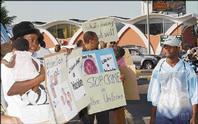
A demonstration in March 2003 by human rights groups on the second anniversary of the 'Braeton Seven' killings.
Yvonne McCalla Sobers, Contributor
MARCH 14, 2004 marked three years since seven young men were killed in a house in Braeton, St. Catherine. Some changes have since taken place in the official approach to human rights in Jamaica, but such changes have been cosmetic rather than integral.
The police account of the 'Braeton Seven' killings that a shootout occurred in which six of seven men received head shots raised sufficient questions for the Director of Public Prosecutions to rule that six policemen be charged with murder.
But what else has changed? Or not changed?
The pace of police killings continues. Police have killed close to 450 persons, mostly males 18-25 years old, since the Braeton Seven were killed. Between January 5 and March 7, 2004, there were 28 police fatal shootings.
The police stories of shootouts remain virtually unchanged from incident to incident. Only names, dates and locations are changed as the public is told after each fatal shooting: "Police were on operations when they saw three men acting suspiciously. The men opened fire when the police approached them, and the police returned the gunfire. When the shooting ended, one man was found injured and was taken to hospital where he was pronounced dead. The two other men escaped. A gun with live/spent ammunition was found on the scene."
. Multiple police killings have continued. For example:
March 2002: Four young men were killed in a canefield at Worthy Park Estate after a shopkeeper saw them taken into custody six miles away.
May 2003: Police killed two women and two men in Kraal, Clarendon, in circumstances that resulted in a Scotland Yard investigation of the incident.
March 2004: Police killed three young men near Frome Estate in Westmoreland. In each instance, the police gave an account of a shootout, and the community said the people were executed.
Police who are involved in questionable killings remain in the Police Force, even if transferred or taken off front-line duty. The Crime Management Unit, associated with about 40 police killings in two-and-a-half years was disbanded after the Kraal incident.
Reneto Adams, taken off front-line duty when his unit was disbanded, has remained a celebrity. The public has generally demanded his return to the streets, attributing recent levels of crime and violence to his absence from active crime-fighting.
Resolution of cases continues to be very slow. The DPP ruled on the Braeton case within six or seven months of the killings. Now, 10 months after the highly-publicised killings with Scotland Yard investigation, the Director of Public Prosecutions (DPP) is yet to rule on that case. The file has been with the DPP since last October.
System failures continue to frustrate the search for justice. Crime scenes can be contaminated, evidence can disappear or never be uncovered, official documents can disappear or be falsified, eyewitnesses can be intimidated and refuse to testify and investigation can be inept.
For example, a jury could find nothing to link Constable Rohan Allen to the 2000 murder of 13-year-old Janice Allen because
The investigator (a policeman) did not give evidence because he was said to be off the island.
An alleged eyewitness refused to be associated any further with the case after he was reportedly a victim of police gunfire (shot in the head and leg) in the same incident.
He spent over a year in lock-up on suspicion of being the gunman shooting at the police when Janice was killed. He was ultimately released without charge, and chose silence as his most prudent route after he was reportedly threatened.
Critical police documents were not produced in court. A record that could have linked Constable Allen to the killing was not presented as evidence. At the inquest, the court was told that the particular page was missing from the police log. At the trial, the court was told that the log was destroyed in a fire at the police station.
The rate of conviction of policemen for fatal shootings is, since 1999, nil. Policemen who, for example, shot seven-year-old Renee Lyons (2003), and taxi-driver Kemar Bryan (2001) were able to leave Jamaica by the time the DPP ruled that the available evidence suggested murder charges. Ordinary citizens would have been immediately taken into custody on murder charges because of the flight risk.
. The rate of police fatal shootings in Jamaica continues to be the highest in the world. Authorities in the United States continue to express grave concern about police shootings in some cities, the average ratio of police killings per 100,000 residents during the 1990s in those cities and in Jamaica is shown below:
Detroit: 0.92 (average 10 persons in population of about one million)
Houston: 0.68
Los Angeles: 0.56
New York: 0.30 (average 28 persons in population of about eight million)
Jamaica: 5.38 (average 140 persons in population of 2.6 million)
Jamaica is admittedly prone to crime and violence, with figures of civilian and police murders also ranking high globally. In the last three years about 30 policemen and about 3,000 civilians have died violently. The 2004 murder of a very senior policeman and an attack on the Denham Town Police Station, has highlighted the vulnerability of those on the frontline of crime and violence. The trend, bolstered by societal fear and panic, has been toward militaristic methods that treat a sector of the population as enemies that have forfeited their rights.
IMPROVED AWARENESS
Nonetheless, during the past three years, the official rhetoric around human rights has improved. Several police stations have replaced their guardrooms with more customer-friendly air-conditioned reception areas. Community policing projects have been launched (yet again). The Commissioner of Police and the Minister of National Security have publicly expressed regret at incidents where police shot dead two 60-year-olds in Flankers (October 2003) and a teenager in St. Thomas (January 2004).
In the context of the Flankers killings, the Prime Minister was quoted as saying that his Government will not "condone the wanton and excessive use of force against law abiding citizens" despite the difficult job facing the security forces in carrying out their duties.
The Minister of Justice said in a statement sent to a February 2004 conference for human rights defenders:
There have been a number of unfortunate incidents in which citizens have been injured or killed through the conduct of state agents. And in this regard, the most regrettable incidents involving Agana Barrett, Ian Forbes and Vassel Brown, the Braeton Seven and Michael Gayle come to mind.
But actions have yet to keep pace with words. Mistrust between police and community has erupted since this year in the stoning of police in Denham Town and Olympic Gardens, in volatile roadblocks in St. James, St. Thomas and Westmoreland where canefields were also burnt. The burning of a section of the Spanish Town courthouse has aroused suspicion of arson.
The culture of disrespect for life and law admittedly takes time to change. However, three years after the 'Braeton Seven' incident, the changes have not been substantial enough.
With a weekly average this year of three fatal shootings by the police and 20 civilian murders, and with increased expressions of anger and frustration at justice and security systems, we may not have time on our side.
Yvonne McCalla Sobers is chairman of the civic action group, Families Against State Terrorism (FAST).