By Lloyd A. Cooke, Contributor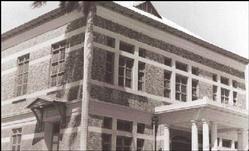
The East Queen Street Baptist Church, which grew through the powerful ministry of George Liele.
- File Photos
IN THE annals of church history and of missions, the place of Europeans in taking the message of salvation to benighted souls is well-known. And all honour is due to them. What is not as well-known, however, is the prominent part played by people of other races.
In regards to the story of the planting the church in Jamaica, the part played in the early days by Black preachers is almost unknown to the vast majority of Jamaican Christians. With no intention of detracting from the debt we Christians owe to our white brothers and sisters, I would like to balance the scales in the interest of the truth by telling somewhat the story of Black missionary and evangelistic pioneers in Jamaica.
The first missionaries to Jamaica were Moravians, mostly Germans and British, or people from America of German extraction. They first arrived at Black River, St. Elizabeth, on December 9, 1754, and focused on the parish. True, the Anglican Church was here from 1655, when chaplains accompanied the conquering Admiral Penn and General Venables.
But, even the late much respected Bishop Percival Gibson had to admit that "It is a blot upon the history of our church that we did nothing in those days for the uplift of the slaves, and for imparting to them the principles of the Christian religion" in Christ for Jamaica, quoted by Bishop S.U. Hastings in Seedtime and Harvest, (pg.11.) This did change, however, with the coming of Bishop Christopher Lipscombe in 1824.
EFFECTIVE MINISTRY
Yet, really effective ministry to the slaves, and an eager response of the Jamaican populace to the message of the gospel, was to await the coming of free Blacks from America in the 1780s following the end of the War of American Independence. The church, not only in Jamaica, but also in Bermuda, the Bahamas and Trinidad, benefited from these Americans. In the case of Jamaica, the names George Liele and Moses Baker are prominent. Liele arrived from Savanna, Georgia, in 1783, having already established a Baptist church in that city. Like many other slaves who had been promised freedom in return for fighting for the British in the American Revolution, they had to flee the newly independent American colonies. Most came on British ships to the Caribbean.
Liele came as an indentured worker and got a job in Customs where he worked to pay back the money loaned to him for his fare. He had been saved and ordained a Baptist minister in Georgia in 1775. Immediately he began to preach in Kingston on the Race Course, today's National Heroes Park. In 1784, he started a church in a home, and by 1791 opened the Windward Road Baptist Church at the south-eastern corner of Elletson and Windward roads.
Out of this church grew today's East Queen Street and Hanover Street Baptist churches. Clement Gayle, in George Liele, Pioneer Missionary to Jamaica, argues that George came to Jamaica not just as a refugee, but decidedly with the intention of preaching the gospel to the slaves. He tells us that "Liele's preaching met with immediate response." In his letter of 1791 to Dr. Rippon, the British editor of the Baptist Annual Register, he reported 500 converts, 400 of whom were already baptised. "We have together with well-wishers and followers in different parts of the country, about 1,500 people."
SIGNIFICANT GROWTH
Liele's work continued to grow. Among his early converts was one Moses Baker, himself an American freed slave. Baker had a spectacular conversion, and was zealous for his Lord. He was hired by a Quaker estate holder from the 'Stretch and Set' plantation near Adelphi, St. James, to teach his slaves. George Lascelles Winn, had bought some slaves in Kingston, many of whom were Liele's members. He also hired Baker's wife to be a seamstress for his slaves Not desiring to separate husband and wife, and hearing that Baker was a preacher, he hired him also to 'teach his slaves'.
Baker established the first Baptist church in western Jamaica the same year that Liele opened his church in Kingston. That congregation, Crooked Spring Baptist Church, later moved to Salter's Hill. It later was the church of Samuel Sharpe, Baptist deacon and National Hero. Thus was Baptist work in Jamaica spread. Later, both Liele and Baker were to write to the English Baptists to send them missionaries, in order to overcome the hindrance to preaching to the slaves that were put in their path by the Consolidated Slave Laws of 1802-1810. The first white Baptist missionaries came to Jamaica in 1814, 30 years after these American freed slaves had began their missionary work in Jamaica.
The Moravians who had arrived nearly 30 years before the America Baptist preachers had seen little growth in their work. A possible cause was because they may have been seen as adjuncts of the white slave society. They had been invited to Jamaica by slave owners, and promised financial support from their estates in north-eastern St. Elizabeth, at Elim, Lancaster, Two-Miles Wood, and Bogue. When these arrangements did not work out well, due to the opposition of the attorneys and overseers who ran the estates, the missionaries were given an 800-acre estate adjoining New River, near to Santa Cruz, which they named 'Carmel'.
MISSIONARY SLAVEHOLDERS
Here they had to keep slaves themselves, as no labour was available for hire to run the estate. Hastings, quoting from The Breaking of the Dawn tells us that "... In order to provide the necessities of life, they had to grow ground provisions and to keep a cattle pen... This... was impossible without slave labour. Consequently, the missionaries became slave holders. Free servants could not be procured... Carmel was worked by 30 to 40 slaves... Very few could be persuaded at any time of their own accord to attend the services. Most of them would only come when they were commanded to do so... for a period of four to five years, not more that four or five would attend, and we think we have the right to 'command them to come in'." After about 50 years of effort, for various reasons, there was little growth to show for it. But change was soon to come, providentially, in the person of a slave named of George Lewis.
Lewis was brought to the attention of John Lang, a missionary at Carmel by another slave, Robert Peart. Peart was from the Spice Grove property on the edge of Don Figueroa Mountain, of what is now Manchester (overlooking the Spur Tree Hill and the plains of St. Elizabeth). Peart had come to faith in Christ through Lewis's preaching. Peart, a Mandingo from the West African coast, came to Jamaica about 1777. He met Lewis who converted him from his Mohammedan faith to accept Jesus Christ as his Saviour.
Feeling that he needed more counselling in his new faith, he sought out Lang, of whom he had heard but not met. He ran to Carmel, a distance of about 16 miles, to meet Lang, eventually joined the church, and became a helper, like an Elder. Lewis, we are told, had gone to America with his mistress, a Miss Valentine, where he had been converted. Returning to Jamaica, his mistress allowed him to go about as a pedlar, and share a percentage of the profits with her, (a not uncommon practice at the time). Much of his peddling and preaching was done in St. Elizabeth and Manchester, the same general area in which the Moravians were active. The Moravians' work had just begun to show some growth.
- To be continued