By Andrew Smith, Staff Reporter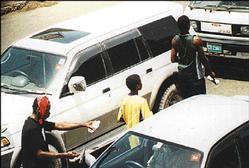
Boys hustling on the streets of Half-Way Tree by the Hagley Park traffic lights in St. Andrew.
- Andrew Smith/Staff Photographer
Winston's story
FOR THE past 12 years, from aged seven, Winstonhas been living on the streets. He ran away from his parents' home at Law Street to escape their ill-treatment and abuse of him. He says his father "likes drinking, and when he drinks nobody can talk to him. (He) is a drug addict he drinks and smokes." When he first went on the streets, "mi father come fi me (and) when a go home 'im treat mi bad and I have to run again. My brother come fi me, the same ill-treatment so mi have to run away again." He repeats emphatically, "I am not going to stay, I am going to run away."
What has he run away to?
Winston spends most of his time on the streets between Half-Way Tree, St. Andrew, and Portmore, St. Catherine. Winston says to survive on the street, "you have to be smart. You have to have discipline with smartness. You have to have manners to big people. Listen when people talk to you (and) don't backchat people."
These rules have served Winston well. When he sees a lady straining with a bag, he approaches her and asks politely, "Miss, can I help you?" If she says no, he continues, "I'm not going to t'ief it, I just want to help you, to get a little money so I can buy a patty and a drink." If she agrees, he will take it to the bus stop and receive between $20 to $200. If he sees a dirty car, "I will take a bucket of water (and) ask him (the driver) if I can wash it.
"Maybe he says no I wipe off the car glass and I still don't get anything." When he's not hustling in Half-Way Tree he is probably in Portmore washing the cars of taxi drivers or walking through the schemes, "begging clothes, food and money".
FIRE BUN
At night, life becomes more dangerous. Winston says, "Some-time you a sleep, you're worrying if people a tek away your money. They will throw water on you, they will light you or tie you up." Lighting is the way that the bigger boys "earn their stripes". Using gas, matches, lighters and anything else they can get, they set fire to the younger boys to prove that they are bad. In Winston's words, "All dem business is that them naw kill you." He adds ominously, "Others don' business 'bout dat. They just do it for fun." Therefore, he ends up having to go to sleep at 4:30 a.m. when other people are on the street who might offer protection.
Another danger which Winston points to are homosexuals who target the boys, especially the younger ones. He says, "Some-times the homosexuals come down in their cars they have money, they try and bribe the kids to come and have sex with them." He says when the younger ones are approached, they call to the bigger guys who will stone vehicles, breaking the windshields and puncturing the tyres. They will also get help from higglers on the street to beat the homosexuals.
THE WAY OUT
There came a point in Winston's 12 years on the street when he decided that he had to make an effort to change his life. He says, "When I get bigger and more mature, I realise that certain things you cannot do anymore (like) sitting on the street side dirty and barefoot." Winston wants to become an entertainer, a mechanic and a soldier. But he realises that in order to achieve this, he needs to go to school to complete his education. He intends to go to evening classes so that he can make a living during the day.
Winston doesn't want to keep hustling. He has made up his mind that "I can't be like this all the days of my life. I want to change, I want to be someone." He wishes for "someone to take me and help me so I can get a little place to put me in, a little work so I can save mi money and buy some food to eat." If this does happen he would like to "turn around and be someone successful. Just like the person that help me I can help someone else. And that someone can help someone else and the country can be more better."
He acknowledges that he is not typical of his fellow street boys. Many of them don't want to take advantage of the opportunities that exist. He gives the example of a skills centre in Half-Way Tree which you attend during the day and on Friday you get a little
allowance. He asks them, "Like how you can do that you don't have to come on the road and wipe glass everyday." The reply is, "Mi not ready for that." Even though at the end of the programme, the person can have his own workshop and tools and work towards saving money, Winston says they are not interested. He says that they can go on the street and "get $3,000 or $4,000 a day without any hard work more than just wipe car glasses."
So Winston has chosen to lift himself from off the streets. Due to his persistence, behaviour, and attitude, he has impressed various organisations which are currently assisting him in any way possible. Hopefully they will be successful so that he can play it forward to others on the street.
Not his real name.
See part two of the 'Street Boys Special' tomorrow.