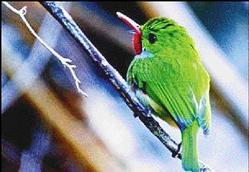
The Jamaican Tody, an endemic bird. - Contributed BEGINNING ON Earth Day - April 22, and ending on Inter-national Biodiversity Day - May 22, 2003, the Society for the Study and Conservation of Caribbean Birds (SCSCB), the largest single regional organisation devoted to wildlife conservation issues in the Caribbean, will co-ordinate region-wide activities focusing on the region's unique bird life.
The month-long annual festival was launched to highlight the fact that Caribbean islands are now recognised as one of the top three areas on the planet for biodiversity conservation given their collective unusually high rate of endemism in bird and plant species, combined with the high risk of extinction some of them face.
According to the International Union for the Conservation of Nature (IUCN), the birds of the Caribbean are more threatened today than they have ever been in history.
Caribbean Endemic Bird Festival is a major initiative of the Society with two specific objectives in support of SCSCB's mission:
To strengthen and grow a network of people who value Caribbean wild birds, biodiversity and the wider environment, and;
To undertake activities to build awareness of the importance, value, and global significance of Caribbean birds.
VALUE OF FLORA AND FAUNA
This initiative is to be spearheaded across the Caribbean and Latin American countries connected to the region by a variety of organisations, including schools, environmental non-governmental organisations (NGO), government conservation departments, local universities and concerned citizens. Support has also been forthcoming not only from leading scientists and conservationists in the region, but also from North America and the United Kingdom.
According to Eric Cary, president of the SCSCB, "It is only when Caribbean nationals as a whole, through widescale education, recognise the value and significance of native flora and fauna can they ever be expected to care and take action to preserve them". Mr. Cary notes that an astonishing 22 per cent of the regions birds are not found anywhere else on the planet, and most are restricted to single islands in the region all of which continue to face the ravages of widescale environmental degradation.
FINDINGS OF STUDY
Here in Jamaica, the festival will be celebrated under the theme: 'Save the Birds, Save the Forests, Save the Trees'. Both BirdLife Jamaica and the Ridge to Reef Watershed Project (R2RW) will host events in recognition of the regional festival. On the first day of the festival, the R2RW will take the U.S. Ambassador to Jamaica, Sue M. Cobb, to Rocklands Bird Sanctuary in the Great River Watershed. In its heyday from the 1950s to 1980s, Rocklands Bird Sanctuary and Feeding Station was one of the most popular tourist attractions in the Montego Bay area.
During this period, the Sanctuary, was graced by the presence of American presidents, among other international heads of state, European royalty, and celebrities. As part of the month-long Festival, BirdLife Jamaica will present the findings of a nationwide Environmental Foundation of Jamaica (EFJ)-funded study outlining the most important forest areas needed to prevent further endangerment of the island's bird life.
Eight Jamaican birds are currently considered species threatened with global extinction, almost all of which are threatened due to the destruction of forested habitat and native tree species over the past hundred years.
The R2RW will also begin the field activities on its Plant-A-Tree Programme during the Festival period to reforest the most degraded areas of the Great River Watershed with commercial lumber and fruit tree crops and encourage a culture of planting trees.