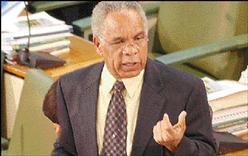
Finance Minister Dr. Omar Davies opens the 2003/2004 Budget
Debate in the House last Thursday. - Rudolph Brown/Staff Photographer
The following is a Ministry Paper, tabled in the House last Thursday
by Finance Minister, Dr. Omar Davies. It outlines new taxation measures to finance
this year's budget.
Members of this Honourable House are invited to take note of the New Taxation Measures being proposed for fiscal year 2003/2004.
1. IMPOSITION OF CESS ON CERTAIN IMPORTS
It is proposed that a four per cent cess be charged on all imports inclusive of capital goods and raw materials. This cess will be treated as a credit Income tax where goods are imported for business purposes and when the importer has presented his or her income tax returns. The exemption from this cess would be applicable where good are imported by:
1. The Government
2. Diplomats
3. International Organisations
4. Passengers (up to the allowance of US$500)
Taxpayers would be able to claim a credit for the cess against their income tax liability for the year of assessment in which the cess was paid. Where the return for the year of assessment is not filed by December 31, following the filing date, that is March 14, no claim will be allowed in respect of the cess paid.
The estimated yield is $3.394B and the effective date will be May 1, 2003.
2. STAMP DUTY ON ITEMS IMPORTED BY IN-BOND MERCHANTS
Tax revenues from in-bond merchants have been minuscule. No indirect tax, apart from a 6 per cent additional stamp duty is levied on goods imported for the trade. It is proposed to increase the additional stamp duty from six per cent to 15 per cent on goods imported for the trade.
This measure is expected to yield $84M and the effective date will be May 1, 2003.
3. EXPANSION OF THE GENERAL CONSUMPTION TAX BASE
During the fiscal year 1995/1996 the GCT standard rate was increased from 12 1/2 per cent to 15 per cent. In an effort to reduce the burden on the poor, however, certain items were placed on the zero rated and exempt lists. This served to narrow the base of the tax and make the system more complex. It is proposed to:
(i) widen the base through:
a) The inclusion of all exempt and zero rated goods and services with the exception of raw material, capital goods, food items presently exempted purchases by the diplomatic community and government, school books, school bags, school uniforms, electricity, water and sewerage in the base which maintaining the standard rate of 15 per cent.
b) increasing the rate on telephone calls to 20 per cent
(ii) remove the facility whereby manufacturers supplying exempt goods are allowed to claim refunds. In 1995 certain items were transferred from zero rated to exempt. The manufacturers of such items were however allowed to continue claiming input tax although this is contrary to the provisions of the Act;
(iii) make sporting goods taxable except under certain conditions. A decision was taken to make sporting goods free from all duties/taxes. The reality however is that this has resulted in a serious loss of revenue especially where certain sporting gears are used by the general population as normal wear. It is proposed that the Customs and GCT Acts be amended to make these items taxable except where purchased by schools and legitimate sporting groups for use in sporting activities.
This measure is expected to yield $8.167B and will be introduced with effect from May 1, 2003.
4. AMENDMENTS TO THE FIST SCHEDULE OF THE ASSETS TAX (SPECIFIED BODIES) ACT.
Companies registered under the companies act, societies registered under the Industrial and Provident Society Act and any other prescribed bodies are required to file an annual declaration of the value of its assets based on its Profit and Loss account and pay a tax prescribed in the First Schedule to the Act.
It is proposed that these rates be increased as follows:
Description of Company Tax
Aggregate assets not exceeding $ 50,000 - $ 1,000
Above $50,000 but not exceeding $ 500,000 - $ 2,000
Above $500,000 but not exceeding $ 1,000,000 - $ 4,000
Above $1,000,000 but not exceeding $ 5,000,000 - $10,000
Above $5,000,000 but not exceeding $ 10,000,000 - $15,000
Above $10,000,000 but not exceeding $ 50,000,000 - $20,000
Above $50,000,000 but not exceeding $100,000,000 - $25,000
Above $100,000,000 - $35,000
This measure is expected to yield $83 million and the effective date will be June 1, 2003
5. REVIEW OF IMPORT DUTY STRUCTURE ON SPECIFIED MOTOR VEHICLE
The aggregate duty rate payable on pickups with unladed weight of over 2032 kg is 35 per cent while that on pickups below this weight is 55 per cent. Pickups fall within the same classification as trucks and the intention is that for the purposes of GCT they will be placed in a separate category and the GCT rate structure revised in order to bring equity into the system where luxury vehicles of a heavier weight presently attract a lower duty than regular pickups and the smallest motor car.
It is proposed that the GCT payable in respect of pickups as distinct from trucks should be reviewed and placed into four categories with the aggregate duties ranging from 55 per cent to 180 per cent for the heavy-duty pickups.
It is, also proposed that the aggregate duties on motor cars (including SUVs) with engine capacity in excess of 3,000 be reduced from 288 per cent to 180 per cent.
The Revised Duty Structure will be as follows:
No Vehicle CET GCT Agg.
1.Cars including station wagons and estate cars
| Not exceeding 1000cc | 40% | | 19.23% | 67% |
| Exceeding 1000cc but not exceeding 1500cc | 40% | 30.769% | 83% |
| Exceeding 1500cc but not exceeding 2000cc | 40% | | | | 38.46% | 94% |
| Exceeding 2000cc but not exceeding 3000cc | 40% | | | 57.69% | 121% |
| Exceeding 3000cc (gas) 3200cc (diesel) | 40% | | | | | 100% | 180% |
2. Jeeps, Range Rovers, Troopers etc.
| Not exceeding 2000cc | 40% | 38.46% | 94% |
| Exceeding 2000cc but not exceeding 3000cc | 40% | 57.69% | 121% |
| Exceeding 3000cc (gas 3200cc diesel) | 40% | | | 100% | 180% |
| 3. Trucks for agriculture | 10% | | 9.09% | 20% |
| 4. Other Trucks - not exceeding 2032 kg | 10% | 40.91% | 55% |
| - exceeding 2032 kg | 10% | 22.72% | 35% |
5. Pick ups
| Compact pickup - single cab | 10% | | 40.91% | 55% |
| Compact pickup - extended cab | 10% | | | 52% | 67% |
| Full size pickup | 10% | 76-364% | 94% |
| Heavy Duty pickup (luxury utility truck) | 10% | 154.545% | 180% |
| Pick ups approved for use in agriculture | 10% | | | 9.09% | 20% |
The measure is expected to yield $500M and the effective date will be May 1, 2003.
6. ADJUSTMENT IN THE AGE LIMIT IN IMPORTATION OF MOTOR VEHICLES
Prior to March 10, 2003 when Jamaica was forced to start applying the provisions of the WTO Customs Valuation Agreement to the importation of motor vehicles, the value applied to the importation of used motor vehicles for customs duty purposes was based on reference pricing. Effective March 10, 2003 the valuation is based on the transaction value. This has implication for the revenue in that the reference prices used are at least twenty per cent above the invoice prices. It should be noted that the prices at which the used vehicles are sold for export in the Japanese market are lower than the domestic prices and therefore are not the same as those in the reference guides.
Presently returning residents are allowed to import a vehicle up to 10 years old while all others are allowed to import motor cars not older than four years and vans/light trucks not exceeding two tons not older than five years (a truck over two tons do not require an import licence).
It proposed that the age limit be reduced to five years in the case of returning residents and that in the case of other persons the motor car should not be older than three years and vans/light trucks be not older then four years. The need for this adjustment has become critical as analysis of the customs duty inflows for March revealed a decline which can be attributed to the implementation of the agreement.
The expected inflow is $180 million and the effective date will be June 1, 2003.
7. IMPOSITION OF AN ENVIRONMENTAL LEVY
Under Jamaica's National Environmental Plan the management of PET bottles was prioritised by government and presently some measure of recycling takes place and while work commenced in October 2001 on a policy for the management of packaging wastes in Jamaica no real progress has taken place.
Over eight hundred thousand tons of municipal waste is generated in Jamaica per annum. Twelve per cent of this waste is plastic packaging material with fifty per cent of this figure attributed to PET containers. Other types of plastic packaging material such as tetrapacks, Styrofoam and PVC are excluded from this figure. Plastic packaging material includes items such as polyethylene (PET) used in the packaging of soft drinks, juices and detergents, low density polyethylene (LDPE) such as trash bags and plastic bottles, high density polyethylene (HDPE) such as beverage bottles, jugs and milk and soft drinks crates, polyvinyle chloride (PVC) which includes durable goods and shampoo bottles and (PS) represented by house wares and fast food packaging (styrofoam).
Between April 2002 and February 2003 the country spent over J$1B on solid waste management with fifty per cent of this cost being met from property taxes.
It is proposed that an environmental levy of two dollars (J$2) per kilogram be placed on containers imported, manufactured and or distributed in Jamaica.
This measure is expected to yield is $192M and the effective date will be May 1, 2003.`8. Removal of Credit for Bonus Share Issue
Given the high cost of loan financing in the 1990's the income tax act was amended in 1994 to allow a company which issued bonus shares from its accounting profits to receive a tax credit of 25% on its income tax liability for a particular year assessment. The intention was to assist companies that were experiencing working capital difficulties.
Since 1994 many local and foreign owned companies listed companies have annually reduced their tax liability by the issue of bonus shares. Cabinet will recall that the taxation of dividends paid by publicly listed companies have been reduced to zero per cent over a three year period even while these companies have continued to enjoy the credit for bonus share issue. Cabinet will also recall that the rationale for the removal of income tax on dividends paid by these companies was that it would encourage the movement of funds from the fixed income securities into the equity market. Presently this is not happening and it is proposed that the credit for bonus shares issued be removed.
This measure is expected to yield $550M and the expected date is June 1m 2003.
9. ADJUSTMENTS TO POLICY REGARDING GRANT OF DUTY CONCESSION ON MOTOR VEHICLES.
Presently allowance is made for certain concessions relating to the payment of import duties on motor vehicles. Under the comprehensive motor vehicle policy relating to the public sector vehicles up to a maximum value of $30,000 f.o.b. are assigned to specified officers with the some limit being applied to vehicles allowed under the twenty per cent duty concession policy. It is proposed that the limit be reduced to US$25,000 c.i.f. with full duties payable on amounts in excess of this. Additionally, the Third Schedule of the Customs Duty Act provides that materials (excluding motor cars) and equipment imported into the island by any person or institution for the purpose of carrying out any works in pursuance of a contract between such person or institution and the Government of Jamaica shall be exempted from import duties.
A practice has developed over the year however where contracts are signed within Ministries and Departments and in which provision is made for motor vehicles, including motorcars are to be imported free of duties. The result has been that contractors and subcontractors on a contract are allowed to purchase motorcars free of duty. Cabinet should know that for the purposes of Custom Duty all vehicles with seating capacity of less than ten are regarded as motorcars. The intention is to enforce the provisions of the Customs Act in terms of the types of vehicles which will be allowed duty free.
This measure is expected to yield $250M and the effective date will be April 22, 2003.
10. INCREASE IN SPECIAL CONSUMPTION TAX ON ALCOHOLIC BEVERAGES.
The special consumption tax rates on alcoholic beverages were last increased in 1995. It is now proposed that these SCT rates be increased as indicated below:
(a) Spirits
(i) In respect of spirits of a strength exceeding 57.1 per cent
alcoholic by volume, e.g. overproof rum, it is proposed
to increase the rate from 24.3 per cent to 30 per cent.
(ii) In respect of spirits of a strength exceeding 31.5 per cent but
not exceeding 57.1 per cent e.g. red rum, it is proposed
to increase the rate from 16.1 per cent to 24 per cent.
(iii) In respect of spirits of a strength not exceeding 31.5 per
cent e.g. rum cream, the rate would be increased from
14.5 per cent to 22 per cent.
(b) Beers
(i) Beer is subject to SCT at two rates depending on its alcoholic
strength. Where the alcoholic strength does not exceed
six per cent of alcohol by volume e.g. Ref Stripe, it is
proposed to increase the rate from 15.1 per cent to 21 per cent.
(ii) In respect of beer exceeding 6 per cent alcoholic strength e.g.
Dragon Stout, it is proposed to increase the rate from 10 per
cent to 16 per cent.
(c) Wines, Cordials and Liqueurs
Wines, cordials and liqueurs are presently subject to SCT at the
rate of 14.5 per cent. It is proposed to increase the rate of 14.5
per cent to 21 per cent.
These measures are expected to yield $444 million and the effective date will be April 24, 2003.
A summary of the measures together with the expected inflows is given below:
SUMMARY OF MEASURES J$M
1. Cess on Specified Imports 3,394
2. Stamp Duty on items imported by In-bond Merchants 84
3. Expansion of GCT Base 8,167
4. Amendments to the Assets Tax (Specified Bodies) Act 83
5. Revision of Duty Structure on specified motor vehicles 500
6. Adjustments to the Age Limit in the importation
of motor vehicles 180
7. Imposition of an Environmental Levy 192
8. Removal of Credit for Bonus Share Issues 550
9. Adjustments in duty concessions allowed on motor vehicles 250
10. Increase in SCT payable on alcoholic beverages 444
TOTAL 13,844