By Andrew Green, Staff Reporter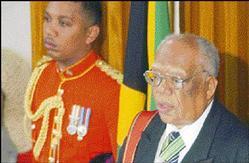
Sir Howard Cooke, Governor-General, delivering the Throne Speech during yesterday's ceremonial opening of Parliament. Captain Mahatma Williams, his Aide-de-Camp, is at left. - Rudolph Brown/Staff Photographer
ALMOST TWO out of every three cents the Government proposes to spend in this year's Budget will go to pay debt, based on the Estimates of Expenditure tabled in Parliament yesterday.
Dr. Omar Davies, Minister of Finance and Planning, presented a $261.4 billion Budget to be debated by Parliament. Of this, $169.5 billion would go to pay debt.
Recurrent expenditure for items such as interest payments and salaries for the 2003/2004 financial year, starting April 1, amounts to $162.2 billion. Proposed capital spending amounts to $99.2 billion.
A $223.5 billion revised expenditure Budget for the last financial year, was presented to Parliament last month by Dr. Davies. In that Budget, 62 per cent of the spending was allocated to debt payment. For the current Budget, 65 per cent of the spending would be allocated to debt payment.
"It is going to spell real difficulties for businesses," said Dr. Omri Evans, economist. The problem is that the non-debt side of the Budget is still rising.
The Budget is $37.9 billion greater than that for last year, with debt payment amounting to $31 billion of this. Thus the non-debt side of the Budget is up by $6.9 billion.
"I expected tighter controls on spending to signal that they were serious in dealing with the large public sector," Dr. Evans said. If the Government cannot control its spending, then they will have to depend on tough measures to boost revenues to even attempt to control the country's massive debt burden, he said.
Largely to manage the debt, the Ministry of Finance and Planning has a budget of $189.5 billion, up 25 per cent from last year.
With a Budget of $23.7 billion, the Ministry of Education, Youth and Culture is one of the top four ministries in terms of allocation, but there is a 0.6 per cent reduction in its Budget this year. Its recurrent spending is set to fall by $300 million, while the capital spending is set to rise by $174 million.
In the Health Ministry, a 1.1 per cent reduction is proposed to bring its budget down to $10.7 billion. Recurrent spending is set to fall by $215 million, while capital spending is to rise by $98 million to $$298 million.
The $14.3 billion budget of the National Security Ministry is down by 4.9 per cent. Recurrent spending is to fall by $112 million, and capital expenditure is also planned to fall by $619 million to $211 million.
"There are no surprises in the expenditure Budget," said economist Errol Gregory. "It just shows the debt dilemma that we are in."
Another issue is the recent trend for the Government to present a Budget and then have as many as two other major adjustments through supplementary budgets later in the year, Mr. Gregory said. Further undermining the integrity of the Budget is the use of deferred financing, which is real spending that is not reflected in the new estimates.
"We really are hoping to see a programme to reduce the debt and help bring back some stability in the financial market," Mr. Gregory said. "That may come later in the revenue estimates."
The Standing Finance Committee of the House of Representatives will start reviewing the Estimates on Tuesday. Dr. Davies will present his proposals on how he plans to fund the Budget when the debate begins on April 17.