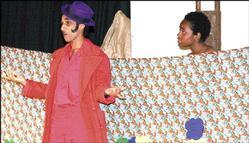
Having been kicked out of Heaven, Lucifer tries his wiles on a susceptible Eve. - Winston Sill/Freelance Photographer JAMAICAN THEATRE often has to battle with the issues of cost and limited stage and technical equipment. This year, the University Dramatic Arts Society (UDAS) used their production The Mysteries to show that when Shakespeare stated that all the world's a stage, he was not joking.
Due to refurbishing of the lighting in the theatre at the Philip Sherlock Centre for the Creative Arts (PSCCA), where UDAS' annual show is normally staged, the group was left without a platform this year. However, they decided to take their show next door, into 'The Round' of the PSCCA. Although it would not be the first time a performance has been staged there, the central square of the round can be a rather limiting space. Nonetheless, the group and their director, Brian Heap, made the space work to their advantage for the staging of The Mysteries, which ended last weekend.
The group helped to define the staging area with the use of screens moved from the theatre to help limit the light and space. These screens were then decorated with crushed brown paper to give an abstract art look. Most importantly, they kept their set and costuming largely symbolic. This is a tactic that more productions, forced to use a small, limited stage should adopt, rather than attempting limited cumbersome sets.
It was easy to suspend reality for the work at hand, because their story was taken from the most read and talked about book in human history (far surpassing even Harry Potter) The Bible. Even so, the play, which is to stretch the definition of the word somewhat, lacks a plot. Instead, it is a collection of some of the most famous stories from The Bible. It goes from the creation of the world to the Resurrection of Christ.
Rather than taking the tale straight from the sacred pages however, the stories were taking from an mixture of different sources. What was presented was an imaginative work, which should be lauded for its originality. It creates an interesting mix of Caribbean and European interpretations of various stories in The Bible.
The first half of the production was based on the York, Chester and Coventry Cycles of the medieval mystery plays. This section of the work included 'The Fall of Lucifer', 'Adam and Eve', 'Cain and Abel', 'Noah's Flood' and the 'Story of Abraham and Isaac'.
This section was therefore said in verse, with injections of Jamaican Creole and the use of Jamaican folk forms. Unfortunately, many of the weaker actors fought an uphill battle with the language. They were evidently not used to speaking outside of prose and were often severely hampered by the rhyming of the lines. The result was the far too familiar butchering often associated with Shakesparean works. This spoke of the actors' own inabilities, as well as the director's failure to get what he needed from them. It seemed to lean greatest toward inexperience, however.
This tied tongue war was lost on actors such as Clive Forrester, who shows both natural talent and growth with his continued participation in the society's productions. Forrester made the language his own and spoke naturally, while still managing to retain the rhythm of the words.
The result was that some segments containing the stronger characters were much more interesting than others. One of those segments was 'Noah's Flood', which benefited from the talents of Forrester and Janel Walters, who played 'Mrs. Noah'.
Unfortunately, though the actors were usually able to tap the comic sides of the stories, they were unable to scratch the dramatic elements. As such, Cain was reduced to a comic villain and the horror of his slaying his own brother was completely lost. Even so, Velmore Coke (Cain and later a priest in the Garden of Gethsemane) was one of the stronger actors in the piece. The drama of the story of Abraham's near sacrifice of Isaac was also lost.
The dramatic nature of the birth of Christ and The Slaughter of the Innocents during the second half of the production was conveyed with much greater effect. This was in part due to a change in styles. This segment was played simply with a montage of music combined with actions, no words, with the music dictating the mood and emotions of the scene, it was much easier to convey intense emotions.
The Mysteries also included sections of The Bible told purely in Jamaican Creole as reinterpreted by The Bible Association of Jamaica.
Intentional or not this segment, the announcing of the coming of Christ first by Isaiah the Prophet and then by Gabriel, came across as hilarious. The hilarity was increased by the lack of any attempt to reduce the scenes to a farce.
The final segment came from an adaptation of Mervyn Morris' series of poems On Holy Week.
Despite any shortcomings displayed, the overall product which was The Mysteries was certainly an enjoyable and laudable production.