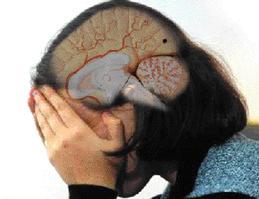
There is a difference in the way in which the brains of depressive girls process electrical waves during sleep when compared to their non-depressive
counterpart - Dr. Stanley Kutcher, Department of Psychiatry, Dalhousie University School
of Medicine (Canada).
THE TURBULENT teenage years form the platform for the onset of many mental illnesses - depression, schizophrenia, social phobia, panic disorder.
Teenagers are more vulnerable at this developmental stage, not because their lives are more stressful than anyone else's but, Dr. Stanley Kutcher, visiting Dalhousie University School of Medicine (Canada) neuroscientist said it is because something is happening to the brain, at that time, in its interaction with the environment.
New models, he said last Friday during a presentation at the University of the West Indies' Medical School, are now needed to better understand mental illness, in particular, depression, in this age cohort.
Depression runs a prevalency rate of between 15 and 20 per cent in children 15 to 18 years old and, in the young girls, the risk of developing depression is twice that of the boys.
"People who were depressed as teenagers do much more poorly than others," Dr. Kutcher said as he tried to stress on the audience of medical students and faculty, the urgency of the problem of teenage depression.
Furthermore, he pointed out that teenagers who fall prey to depression run a 70 per cent chance of the occurrence of another event.
To produce the data which can inform new models for addressing teenage depression, Dr. Kutcher and his research team are studying girls who are at high-risk for depression these are girls whose mothers have suffered depression. When these girls are compared to the control group in the study, the researchers are finding no significant difference in the way they cognate or think, neither are they able to substantiate the hypothesis that attempts to associate a lack of social support with depression. However, they are coming up with some interesting factors associated with depression, for example:
depressed girls have a much earlier onset of their menses than their non-depressive cohortin the sleep laboratory there is a difference in the way in which the brains of depressive girls process electrical waves during sleep. Dr. Kutcher said, in fact, that nothing else but the electrical coherence data (produced in the sleep laboratory) predicts which girls will become sick.
Further exploring the neurobiology of depression, he believes that the evidence could be indicating that depression and other psychiatric disorders may be degenerative brain diseases. To support this theory, Dr. Kutcher pointed to MRI scans of the brains of girls in the study groups pointing to differences in the size of the region of the brain known as the hippocampus. In the depressed children, he said, that the size of this region of the brain was smaller than in normal children.
"At age 13, 14, 15, these kids (the depressive ones) already have a degenerative effect in the hippocampus," he stressed.
The researchers are continuing to study this hypothesis.


















