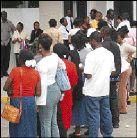
Visa line at the British High Commission last Friday.Lloyd Williams, Senior Associate Editor
PERSISTENT FAILURE of the British Government to stem the flow of cocaine from Jamaica into their country, coupled with the number of brutal slayings on their soil recently, may have been the straw which broke the camel's back in the United Kingdom visa issue.
The imposition on January 9, 2003 of visa requirements for Jamaicans wishing to visit the United Kingdom did not at all come as a surprise to people who had been watching certain developments there.
It cast its shadows in the trafficking of cocaine smuggled from Jamaica and the concomitant adverse publicity -- and real foul-ups -- caused by dozens of the cocaine swallowers arrested at London's airports. Gun violence by the "Yardies" (as Jamaican gangsters in the UK are called) as they battle each other for turf to peddle crack cocaine on the streets of London and other cities in the United Kingdom is also to blame.
Indeed, from as far back as July 1999, David Lidington, a Conservative MP, had called for visa controls to be imposed on visitors from Jamaica to curb Yardie violence on the streets of London.
According to Mr. Lidington then: "One option which Home Office Ministers should be considering in the light of the spate of murders in London is to impose a visa requirement on visitors from Jamaica. This might be one way of helping to provide a check against criminals coming into the country."
Critics of visa control argued then and subsequently that the
requirement of visas would discriminate against law-abiding Jamaicans who want to visit their families, thousands of which had emigrated to Britain since the war, and especially in the 1950s and '60s.
Others accused Mr. Lidington and people of like mind, of playing the "race card".
The murders he referred to were thought to have been the result of gangs battling for dominance over the cocaine and ganja (marijuana) market in London and elsewhere. The battle over drug turf has only grown worse since.
Up to Wednesday, January 8, all a Jamaican needed to be allowed into Britain, was a return ticket, landing money, and somebody at the airport at which he lands to convince the immigration officer that he would sponsor the visitor's stay so the visitor would not be a charge on the state during the six months he would routinely be given.
Bob Ainsworth, Britain's Parliamentary Undersecretary of State at the Home Office with responsibility for Anti-Drugs Coordination and Serious Crimes, visited Jamaica in April 2002 to discuss both countries' drug problems with his counterpart, Peter Phillips, Minister of National Security. The question of whether Jamaicans, because of the high incidence of the smuggling of cocaine into Britain should be required to have entry visas, was put to him on April 9 at a news conference at the British High Commission, Trafalgar Road, New Kingston. He said the issue was under review but Jamaica had not been singled out.
"Our position at the moment is that visa requirements for Jamaica are kept under review as they are kept under review for everywhere else... I am not able to reassure you that we would in no circumstances go down that road, but equally, I am not telling you that that is a solution that we have come to... a decision that has been taken", Ainsworth said. On cocaine smuggling, he said: "We are dealing with a very sophisticated, well-financed, highly-profitable international trade, and it's causing problems in many, many countries."
NOT PERSUASIVE
Dr. Phillips argued against the imposition of visas. He said: "...We are going to try to assure to the full extent possible the British public and the British Government, of our good faith by doing, continuing to do and even strengthening, all our efforts to combat the illegal trade in narcotics and to enforce such controls through collaboration that will stop the bad people from going through and allow the ordinary citizens to proceed about their business."
Apparently, he wasn't persuasive enough and K.D. Knight, Minister of Foreign Affairs and Foreign Trade was even less convincing. But as Mr. Knight said, "We have to accept the responsibility".
What had brought Dr. Phillips and Mr. Ainsworth together was the recognition that their two countries could not stop the cocaine scourge at their own borders, acting on their own without cooperation across international boundaries.
Since then, the UK has put its money where its mouth is, providing technical assistance to Jamaica by equipping the two international airports here with IonScan drug trace detection machines to thwart the cocaine couriers.
In addition, arising from that and subsequent visits to the United Kingdom, have been agreements with the U.K. Government to broaden the focus of the current counter-narcotics operations to include intensified efforts to stop criminal gangs which operate across borders and general criminality which they spawn in the course of their drug dealings.
Specifically, the British have agreed to provide operational assistance to set up a National Intelligence Bureau in the Jamaica Constabulary and will follow up with equipment and training support. The bureau will encompass all the constabulary's intelligence-gathering operations. Also, Scotland Yard will do a needs assessment for the constabulary's counter-gang strategies and as part of intelligence co-operation between the two countries, will be sharing databases on community gangs operating here and in the UK.
EMPHASISING THE POSITIVE
In making the announcement on January 8, 2003 about the visa requirement, David Blunkett, the British Home Secretary, emphasized the positive, pitching it as a time-saving measure to ensure the smooth passage of law-abiding visitors through immigration at UK airports. According to him, the visa requirement would help prevent delays of two hours or more at UK immigration control for people arriving on Jamaican flights and so make it easier for genuine Jamaican visitors to enter the UK.
The long delays, he said, were the result of a large number of Jamaicans nationals refused entry at UK ports. Significant numbers abscond once granted temporary admission to the UK, he added.
But the harsh truth is that this is only a part of the equation.
A spokeswoman for the Home Office conceded that the new policy would aid the British Government's battle against the smuggling of drugs from Jamaica. The Telegraph newspaper quoted her as saying: "This policy has been introduced for immigration reasons, but obviously, we are in very close co-operation with the government in Jamaica which includes the fight against drugs."
On the immigration issue, Mr. Blunkett and the Home Office disclosed startling statistics.
Mr. Blunkett: "At our main ports of entry in the run up to Christmas, Jamaican nationals accounted for around 20% of all passengers refused (entry). I have also become concerned about the unacceptably high number who come to the UK as visitors and then abscond - more than 150 a month during the first half of 2002.
"Figures from one airline demonstrate the worrying extent of this problem where children are concerned. Last year only half of those who arrived at Gatwick went home again.
"I understand that some will have concerns about these new arrangements but effective border controls are an essential part of proper immigration control."
The Home Office gives the stark statistics. In 2001 six per cent of all Jamaican nationals arriving in the UK were refused entry - 3,340 out of 55,6000. From January to June 2002 more than 1,000 Jamaican nationals absconded after being granted temporary admission.
(It got so bad that at one stage the immigration authorities began holding onto the passports of Jamaican visitors they allowed in for a short time.)
In the six weeks to December 17, 2002 the total number of Jamaican nationals refused permission to enter through the 12 busiest ports was 1,233 or 19.6% of the 6,301 passengers refused entry at those ports in the same period. In 2002 British Airways recorded the arrival of 1,202 unaccompanied minors arriving at Gatwick North from the Kingston, flight. During the same period only 592 returned home.
Two major factors in the wake of Bob Ainsworth's visit to Jamaica seemed to have tipped the scale in favour of the imposition of more stringent immigration controls. The first is the smuggling of cocaine by swallowers and the second is the escalation of gun violence. In addition the brutal gun murders in Aston, Birmingham, on New Year's Day of teenagers Latisha Shakespear and Charlene Ellis who were attending a party put on by a Jamaican hairdresser, seemed to have made up the minds of the Home Office policy-makers that visa restriction was the way to go. The shooting of the two innocent teenage girls shocked the nation. According to The Times newspaper, police described the killings as "exceptional in their brutality and unprecedented".