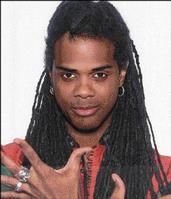
Andru DonaldsChaos, Freelance Writer
ANDRU DONALDS is probably one of the most famous Jamaicans you have never heard of.
You probably have heard him, but never heard of him. Not quite making sense?
Put it this way - here is an individual who has had numerous top ten singles across Europe and South America, has sold millions of albums on a worldwide basis and has been sought after by some of the world's top music producers.
However, most Jamaicans will probably only know him on the basis of his international hit Mishale - Mishale, what am I supposed to do/Mishale, I'll never get over you/Mishale (Mishale), loving you is heaven/Missing you is hell and I need forever to be strong - a fact Donalds contributes to the influence of the North American music market on the collective Jamaican consciousness.
"In some ways I wish that, O.K., there was more of an avenue for people to see and hear the music that is going on otherwise than in America, but when you don't have the management and so on here -- I have not done that much promotion here, just a jam session or two-- nothing like Reggae Sumfest-- it's partly my fault as well. If you can't succeed at what you are doing, you take the high road and do it elsewhere, but then you have to remember where you are coming from."
This is exactly what Andru Donalds did. While he was 'discovered' as it were at age seven while at Mona Prepatory in St. Andrew, he has always known he can sing.
"I was taught by Noel Dexter, Paula Bellamy, Mrs. Vidal Smith - the best in classical music (in Jamaica) at that time. Mrs. Vidal Smith heard my voice out of a group of 60 people and told me to stay behind. I was seven years old and soon I was doing solos in choirs, I was doing Festival and winning gold medals, I started performing all over the island."
The Sunday Gleaner and Andru Donalds are conducting this interview at his childhood home in Mona Heights, St. Andrew.
His dreadlocks are a something of a mess, frizzy, as they stretch their way towards his waist and he does not seem to have shaved recently, which would help to explain his refusal to have his picture taken.
"My manager would kill me if I took a picture while I look like this," he demurs.
Donalds is tall, talkative and, for someone who has sold millions of albums worldwide, he does not seem in the least bit vain.
However, he does have his quirks, such as refusing to divulge his age. The question is, how did a born Jamaican get 'into' pop and rock music?
"When I was growing up my father had a lot of Beatles records, I was always into them, Frank Sinatra, Nat King Cole... as I grew up there was a difference in terms of who I was listening to, there was Led Zeppelin, James Brown..."
A self-proclaimed 'uptown youth' Donalds was not really exposed to the island's indigenous music until he started high school - in his case, Jamaica College.
"I was more into reggae then, I was exposed to more aspects of life... I was a very rebellious kid."
Asked to explain, he said "How you carried yourself, how you dress, in those days wearing earrings to school was... (smiles). Staying away from class, going into record shops - we were into music. There was this record shop - Cooya - which was owned by David Minott and we used to hang out there and 'skull' school.
"In school, we used to hang out in particular 'bad boy' gangs, I was an uptown kid but I used to hang with the Downtown guys and these were the guys that exposed me to reggae, the old style and the new style, it was through these guys that I realized what I was missing out on in my own culture.
"Rock was always about rebellion, just like rap is nowadays, it's funny how you see the times change and how the youths carry themselves," he explained.
Donalds left Jamaica College when he was '15 going on 16' and that was pretty much it when it comes to formal education for the singer.
"I hooked up with Andrew Simpson and we made a band on the UWI (University of The West Indies) campus," he says.
The two would go on to be part of various bands, none of which really got of the ground, but did provide the chance for Donalds to further hone his singing and for Simpson his guitar playing.
When asked how he supported himself during this period, he said "At that time I was doing a lot of voice-overs, writing them, I made a lot of money and saved it. I got into it through Peter Couch and Perry Tole of Native (the band).
"I met a lot of influential people, but in those days, what we were doing... it was much more difficult, that's when I just pushed out..."
He took the money he had saved and with the support of his parents, left for England.
"There was no time no way anybody was going to give you the push with the type of music I was doing. I was hard-headed and I wanted to get into the rock field."
So he left.
"It was rough. I was taking my tape around, trying to meet the right people... I think it was the luck of the draw, I had a number for Mykal Rose at his management firm, Park Music. I was ready to go to the airport when I got him. I immediately got on a train to Campden Town, that how I got linked up to Park."
Park Music at the time managed one of the biggest acts in the world then, Terrence Trent D'Arby (Sign Your Name).
Unfortunately, the move was not all it cracked up to be.
"There were lots of drugs. I never touched it... there were lots of everything. We were trying to record demos, see if we could get a record deal, but lots of money that was supposed to be used for demos went up people's noses - even money for everyday food was a struggle, we had to be frying dumplings..." he recalls with a smile.
"You have to fight your way through, I learnt a lot from the way I was living abroad, in London, New York, without family and friends, it was hard. It gave me tenacity, the struggle gives you savvy," Donalds said.
By this time his friend Simpson had joined him in England and they hooked up with Dennis Wright.
The three snuck off too New York to meet Bruce Garfield (who managed Grace Jones) and Alan Jacoby.
"It was a situation where you had to sneak off without letting anyone know. We hooked up with Eric Foster White (a producer who has done work with Hi-Five, Whitney Houston and Britney Spears) but nothing came out of it. It was the kinda situation where you felt like giving up, we were living hand-to-mouth.
"We came back to Jamaica for a little while. Simpson went his own way, I called Eric Foster White, sent off my tape with my ideas to him and he liked the ideas - he always liked the voice. He spent his own money and flew me to Florida, we recorded some demos (again using Foster White's money), people liked it, we did a showcase in New York and after some nail biting, we were offered deals by three companies. We went with Capitol (Records)."
When asked why Donalds said; "They offered less money but more commitment."
Out of this came his first album, the self-titled Andru Donalds and the megahit Mishale. Ironically, the very success of the single helped to contribute to the album's downfall. Actually, downfall may be a bit harsh, but it did not reach the heights it possibly could have.