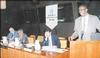
- ContributedEric Crawford, PricewaterhouseCoopers partner, was the guest analyst at the Jamaica Conference Board's (JCB) forum on 'The implications for business of the 2002-2003 Budget.' Others at the table are JCB Chairman Desmond Blades, Finance and Planning Minister, Dr. Omar Davies and Jamaica Chamber of Commerce President, Anthony Chang. The forum was held at the Jamaica Conference Centre in Kingston last week.
Andrew Green, Staff Reporter
WORKING Jamaicans are shouldering a bigger load of the country's tax burden, says Pricewaterhouse-Coopers partner Eric Crawford.
Taxes from employees collected through the PAYE system increased last year while taxes on interest, profits and dividends fell, Mr. Crawford said. He was speaking at the Jamaica Conference Board's forum on 'The implications for business of the 2002-2003 Budget' at the Jamaica Conference Centre in Kingston last week.
"Poorer people are bearing a disproportionate share of the burden," Mr. Crawford said. And this is occurring in a situation where Jamaicans are among the most heavily taxed people in the region, based on a comparison with a select group of countries.
In the last financial year, Government revenue from PAYE increased by $3.5 billion to $19 billion, he said. Tax on profits declined to $6.8 billion from $8.1 billion and tax on interest and dividends also declined by $2.5 billion
Collection of General Consumption Tax increased by $712 million to $34.6 billion, he said. This was $2.5 billion below target.
Government collected 2.7 times more from PAYE than from business taxes, he said. But the overall tax burden, including business taxes is high by regional standards.
And the high taxation is not just on the employed. The country generally is heavily taxed.
Comparing Government revenue as a percentage of gross domestic product, the Jamaican Government collected a bigger share of the country's output than Governments in Costa Rica, the Dominican Republic, Barbados or Trinidad and Tobago, he said. The Jamaican Government collects over 30 per cent of the national income in taxes while in Costa Rica, the take was just over 20 per cent in the year 2000, he said. In the Dominican Republic, the tax take was about 15 per cent.
Compared with other countries
"We are not at very high tax rates," compared with other countries in the region, Mr. Crawford said. The difference is that Jamaicans get fewer tax allowances. It is difficult to compare the situations but "the nominal tax rate could be misleading," he said. On a similar income "you pay quite a bit more than someone else," in the region.
Despite the appearance of relatively low nominal tax rates in Jamaica, "by the time you work the system and calculate the taxes and look at what Government consumes, as a percentage of GDP, Government's take is very high, at least compared to these countries," he said. "If you assume it is not good for business and for growth, then I think it is something the Government ought to be concerned about."
And one issue which could impact on revenues this year is Jamaica has agreed to change over to the WTO system of valuations of its imports, he said. It was slated to have been carried out in April last year and, "Customs officials tell me we are on the verge of it."
Few people understand the significant impact this has for Government and for business, he said. Most think it is going to mean a reduction in customs revenues but, "we will see."
The performance of the revenues confirms the perception that Jamaicans are heavily taxed, Mr. Crawford said. The Government is still absorbing a relatively high percentage of our production. "And what is worse, is that I am seeing several major companies with massive tax losses," he said. "They aren't going to be paying taxes for the next two or three years."
The companies which have been exempted include "some of those companies that have recently been divested," he said.