LONDON:
WHY DO so many Jamaicans, especially women, put their lives in great danger for payments which can range from between J$66,000 and $337,000 per trip depending on the amount of cocaine they can swallow or insert into their bodies?
Ms. Olga Heaven, director of the UK charity 'Hibiscus' which campaigns for the welfare of the inmates while they are in British prisons, said most of the women are single parents from deprived areas. She said: "The typical 'mule' is in fact a poor, unsophisticated, naive, poorly educated woman in her mid-30s, a lone parent who is the sole provider for four or five children, sometimes also an aged or sick parent. She tends to be unemployed, partly employed, or self-employed as a small-time higgler, dressmaker, or hairdresser.
"Most come from inner-city communities... some complained of being threatened or forced to carry drugs by dealers or friends, while others claimed they were set up, or ignorant of what they were carrying. There is occasionally quite graphic police evidence to back up the claims of these victims. In one recent case, a woman claimed to have been raped and buggered by two men who inserted packages of drugs in her anus. She was not believed until the doctor who examined her testified that she suffered severe trauma, and that the insertion involved a great deal of force. Unfortunately there was not much sympathy in the courts and she was given an 11-year sentence."
Ms. Heaven also said that many of these women are traumatised from the moment they set foot in a UK airport. She said: "It is perhaps her first trip outside Jamaica and the size, crowds, noise, affluence, and alien atmosphere overwhelm her. She has been convinced that the job will be easy. Just drop her load, collect her money, and return to her children. She is not even dressed for the English weather, and cannot understand the accents of those confronting her behind the desks.
"Her harsh sentence, based mostly on the quantity and quality of drugs, is one long nightmare, thousands of miles away from dependants and loved ones she may never see again. As a first-time offender, she is not used to the culture of prison life, on her first trip to England - the damp weather, bland food, clothes, and secular atmosphere are all alien. In prison she is given some opportunity for employment and education, but when deported she is worse off than when she left Jamaica so many years ago because, as a foreigner, she is not entitled to any resettlement counselling or discharge grant by the UK authorities."
A PRISONER'S STORY
The following interview with a female drug smuggler now serving five years in a British prison gives an insight into the circumstances which drive many to try such desperate measures to earn a living.
Angela (not her real name) is a 42-year-old mother of four from Kingston. She was caught by Customs officers at Heathrow Airport in May 2001 carrying 84 packets of cocaine inside her stomach. They had a street value of around $3 million. She is now serving her sentence at Send Women's prison in Surrey, just outside London.
Before she embarked on her first and only drug run to England, Angela used to earn a living from selling baby nappies at street markets, pulling in around $2,400 a month which is less than £35. Her two youngest children, an 11-year-old girl and a 16-year-old boy, were still at home -- a one room in a shared house, for living, eating and sleeping, with just an old TV, an old table and a bed.
Angela suffered from asthma, and the bills for medicine were taking everything she earned. She recalled: "I was down to my last $10. My children's clothes were shabby and my mother was helping with food, but all I could afford for them were biscuits and box drinks. When you reach that level in Jamaica, you are finished. I told God I didn't want to go on living and asked Him to take me.
"Then a friend said I had to meet this guy who could help. The druggists are on the look-out for people who need the money and usually they are like me, single women with children and no job and no hope of support. There were three guys who spoke to me, but the main man did not try to pretend. He told me the work was carrying drugs to England. But I never knew it was cocaine, or what it was worth. I never knew lots of things I do now."
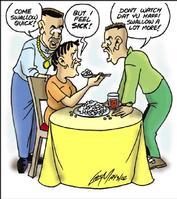
Angela later found out that swallowing the drug packages was the most terrifying part of the mission. She went on: "The flight was in the evening, and that morning they took me to a hotel in Kingston and laid out the packages I had to swallow. They were wrapped in clingfilm and coated in candlewax and then tied inside condoms. I swallowed 10 at a time, then I would rest and drink some fruit juice, and all the time they were telling me 'you have to swallow more!'
"It was really painful. I was crying for my mother at one point, but they made me carry on. I was sick and some of the packages came back up, but they just made me swallow them again. I was scared the packages would break, but they said it had never happened.
"Then I was scared about getting caught. They lied and told me I was going to Gatwick, which was a tiny airport without even a computer. In London I was to find my way to a cheap hotel, book in for a couple of days, and then just wait until I had passed all the packets. Then I would call a number back in Jamaica and arrangements would be made to collect the drugs.
"In two weeks' time, they promised, I would be home again with my children, $270,000 richer - I have since been told the street value of the coke would have been more like $3 million.
"But if I had made $270,000 I would have had my dream. I would use some of the money to set up a small shop and some to send my children on to high school. I looked at these guys, in their designer clothes and 'criss' cars and thought they were my only hope. By the time I was on my way to the airport, it was too late to change my mind."
Angela recalled the agony she went through on the long flight and the moment she was arrested at Heathrow airport in London. She went on:
"My stomach was aching from the packages, but I managed some of the meals on the flight and plenty tea. The guys warned me to eat and drink, to avoid attracting attention, but said coffee could damage the packages.
"I knew then what I was doing was dangerous. But the way things were at home I was going to die anyway - at least now I had a chance to save us all. I just kept that in my mind - the picture of my children looking well fed and healthy, and of our little shop in a better neighbourhood.
"By the time I got off the plane, I was doubling over with pain, trembling and sweating. My body was beginning to react to the strain of the packets of cocaine in my stomach. I still remember the Customs people who spotted me. Even though they were arresting me, they were so polite. No one had ever shown me that sort of kindness before in my life."
After being arrested, Angela believed what the drug gang had told her, that she would be sent back home on the next flight. To her shock and horror she later found out that she would be spending a long time in a British prison instead. She continued: "At first I denied I was carrying anything. Then the officers took a urine test which showed suspicious traces. I knew it was over and admitted everything. But it was a shock to be sent to prison, let alone for so long.
"The guys in Kingston had told me that if I was caught, the worst that could happen was I would be sent back to Jamaica on the next plane. But now I am serving a five-year sentence. With good behaviour, I hope I will be going home in 2004. My son is being looked after by his father. My daughter is with relatives. He knows what has happened to me, but she does not. If my mother found out, it would kill her. When I call her on the phone I tell her I am at college in England. In a way, it is true. I have learned how to sew and I am saving five pounds a week out of my prison wages. I hope it will be enough to buy a sewing machine when I get home and I will set up a business as a dressmaker.
"I was misled into a false dream. But I am still hoping something good will come out of this. I have done wrong and have to be punished, but you have to understand what poverty means in Jamaica. There is no welfare, no national health service, no help for the needy, not even school is free. But I did wrong and I deserve my punishment - an English winter in an English jail."
TOMORROW: FOCUS ON THE JAMAICAN YARDIES.