By Balford Henry, Senior Staff Reporter 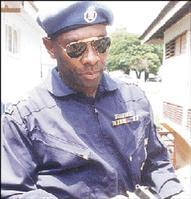
Reneto Adams
SENIOR SUPERINTENDENT Reneto Adams, Head of the Crime Management Unit (CMU), yesterday suggested "getting rid of 25 main dons" to resolve the country's crime problems.
SSP Adams was responding to questions from Janet Nosworthy, counsel for the West Kingston Commission of Enquiry, as to what were some of the measures he felt necessary to deal with the current crime problem.
SSP Adams said: "My feeling is when Jamaican people will have found their backs firmly against the wall, with no alternative of escape and survival, that is the primary one.
"Two, I think that if we started now by being united, working together, all levels of society, the NGOs, Government organisations, everybody in their community trying to do something, try and expose these people.
"(Three) I detect no more than about 25 hardened criminals in this country that are making problems...They are the ones who have, on the ground, organised gangs. If they are gotten rid of by being sent to prison or otherwise, I am quite sure that what is on the ground can be dealt with."
He said that when he said 25, he was really focusing on the "dons," as there were other criminals, but they operated at the command of the "dons."
He said that almost every police station had a "don" generally in "close proximity as if they are a contending force."
"Some have control over the particular stations and its members and I have problems executing my job, consistent with the law, in these circumstances," he said.
He said that some business people were in agreement with extortion by criminal gangs and had no problem paying it and "tack it" on to their prices. Some of the businessmen came up through the criminal networking and had become rich businessmen and some were still involved in criminal activities, he added.
He said that the money from extortion and drugs trafficking, were being used by organised crime gangs to buy arms and "pay soldiers on the ground," as police intelligence did not show any other source of financing.
Turning to community policing, SSP Adams said that it was not a new phenomenon and was in place from 1967, when he joined the force.
He explained that community policing involved people participation, the police as facilitators, "interacting with the community, living with the people and respecting their rights."
However, he warned that community policing was designed for "a real civil society," or a society which is behaving in a civilised way.
"In other words, the policeman exercising community policing should not be carrying a firearm, should not be dressed like you see me dressed sometimes, should not be in squads... but many communities in Jamaica do not allow us to do that. They are dangerous," he said.
"Community policing suggests also that when I am on beat duty with my other fellows, I could stay here and see him four chains away on, either side, so If I were in difficulties I could blow my whistle and call him and he would come to assist.
"In Jamaica when I patrol some of the time and go in these lanes, you see no further than a yard to your right and left and no further than a yard to your back and zinc. Now people shoot through these fences on you and so on. Those places, I suggest, are not conducive to community policing."
He said that community policing was also misunderstood, because it suggests a zero tolerance approach.
"For example, if a man was urinating on a street corner in your psychology it shouldn't be that you just wanted to pee and therefore he had to do it. My philosophy is whether he was burning, he shouldn't pee there and should either be prosecuted or warned," he said.