
CARICOM as functioning antique - Integration flounders on creaky regional structure
Published: Friday | July 3, 2009
Wilberne Persaud, Financial Gleaner Columnist
Once I began contemplating CARICOM conflicts and possible approaches to solution, it hit me.
In consecutive columns I will have addressed comments of the top brass of GraceKennedy Limited, even though one is on secondment operating as a minister of government.
But I concluded nothing's wrong with that.
After all, I also consider comments on CARICOM by great Caribbean novelist, Barbadian George Lamming from whose In the Castle of My Skin Edith Clarke took the title of her highly regarded work on Jamaican family structure, My Mother who Fathered Me.
Perhaps more importantly, I figured that folks must agree that being among Jamaica's oldest and most profitable business operations, GraceKennedy's executive group should include people whose opinions on matters of business and governance ought genuinely to be worthy of serious consideration.
Lack of proper buy-in
So what did Lamming have to say? Let me admit, I am here reporting third-hand because of our lack of proper buy-in to the technological change necessary for growth and modernisation. Lamming was speaking at a ceremony at the Errol Barrow Centre for Creative Imagination.
He lamented the fact that our leaders allowed the original integration movement to flounder on the rocks. He, however, highlighted the reality of most of our current leaders being University of the West Indies (UWI) alumnae.
Given ongoing conflicts over trade and migration, integration seems again to be on the rocks. Somewhere, therefore, in the process, he argued, UWI had faltered; commitment to regionalism had been lost.
I cannot verify my report of Lamming's comments although there is software available from multiple providers that instantly convert voice to text.
Yet at the foremost institution of learning in the Caribbean, we rely on transcription services of a secretary, headphones and tapes or DVDs. This is a huge problem.
Some 90 per cent of computers used in these environments are nothing but glorified typewriters. For technological change to make positive impact it requires not merely artefact of knowledge embodiment - hardware.
It requires mind-set alteration among its users.
We obviously, have not yet grasped this. So my attempts to have a transcript of Lamming's talk failed. The secretaries have not yet had a chance to transcribe.
It reminds me of a visit to Devon House in Kingston many years ago when our guide said a particular room was out of bounds because, "They haven't yet finished making the antiques".
In this case the antique is present and functioning!
This scenario feeds into what GraceKennedy chairman and chief executive officer Douglas Orane (see Sunday Gleaner, June 28, 2009) was proposing as lessons that could be learned by CARICOM from systems his company instituted.
Today's technology allows for teleconferencing and other forms of 'virtual' meetings that can achieve much, including cost cutting, once folk are tuned into the possibilities and willing to overcome their phobia for new ways of doing old things.
CARICOM hosts too many meetings that appear to have no real world, 'ground-level' outcome. It is, indeed, as if progress is measured by meetings and speech hours, level of applause, acceptance, and column inch of reporting.
Orane, after hoisting his bona fides as a genuine 'Caribbean man', argues in the article that "countries are tempted to seek individual solutions based on their relationships with players outside the region".
There is an "emotional response of 'every man for himself' or, in this case, 'every country for itself'," he says.
He notes, "a specific example is the recent report that at the special session of CARICOM leaders on May 24, a team was commissioned to come up with recommendations on the region's approaches to the global economic crisis, even while we are yet to move on a draft report that was submitted by another task force mandated in January by the region's finance ministers."
This is what I refer to as no 'ground-level' outcome.
Regardless of number and quality of speeches, resolutions and agreed protocols, where there's no wise implementation, all is naught and one from 10 is indeed Eric Williams' 'zero!'.
Negotiation by sound bites
Admittedly and expectedly, a problem of internal migration in the region exists.
Instead of evidence-based, real time, online data being put together and analysed for the potential impacts - negative and positive - on the various sending and receiving countries, we are faced with negotiation by sound bite, press release or coverage as Guyana, Barbados, Antigua and St Vincent leaders speak to and over the heads of their respective constituencies and/or each other.
All life forms forage, seeking environments of greatest potential for their success - like swarming bees, and Wildebeest on the Serengeti Plains in their annual migration.
Humans are no different: Mexicans in California, Texas and Arizona, Turks in Germany, Guyanese and Vincentians in Barbados or Antigua.
Both sending and receiving countries experience positive and negative outcomes as humans migrate.
This problem requires mature, negotiated settlement.
If we can't settle our internal migration issues, how will we respond to Organisation of Economic Development and Cooperation (OECD) countries' restrictions on Caribbean peoples' efforts to migrate? Problems of trade, protectionism, tariff regime change and fallout in financial services should be subject to the same path of mature negotiation.
Our region is replete with more than adequately skilled and trained people to achieve these tasks in timely fashion.
Fact is, however, there is alive a notion that the old, existing tried and tested intellectual manpower, orga-nised in its present form is up to all tasks.
This is absolutely untrue. CARICOM needs an elemental overhaul in the way it conducts business and 'implements' proposed solutions. I find myself in complete agreement with Orane that as GraceKennedy transformed itself for 21st century operations, so too must CARICOM. To "survive as a regional body with any authority and legitimacy, the CARICOM region ... needs to go through a process of self-transformation," he said.
Today is not too late, tomorrow however, might be!
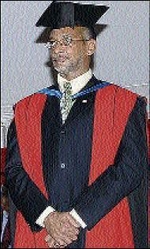
Douglas Orane, chairman and chief executive officer of GraceKennedy Limited, is seen here in May 2008 at his conferral of an honorary Doctor of Laws degree from the University of the West Indies. Orane in a speech on June 13, has re-energised debate on Caricom's structure and its measurable outcomes. - File
wilbe65@yahoo.com