Sections
- Lead Stories
- News
- Business
- Sport
- Commentary
- Letters
- Entertainment
- Arts &Leisure
- Outlook
- In Focus
- Social
- Auto
More News
- Power 106 News
- The Star
- Financial Gleaner
- Overseas News
- The Voice UK)
- Communities
- Hospitality Jamaica
Archives
Services
Subscriptions
Interactive
About Us
News Links

Christmas-tree farming an art in Penlyne Castle
Published: Sunday | December 14, 2008
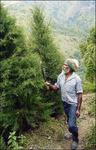
Photo by Gareth Manning
Mansy Hardy takes a little time to 'airbrush' his works of art on his Christmas-tree farm in Penlyne Castle nestled in the cool Blue Mountains of St Thomas.
Gareth Manning, Staff Reporter
JOURNEYING TO the cool, misty inclines of the Blue Mountains conjured up a child-like thought of an adventure to the North Pole to visit good old St Nicholas and his busy elves.
Except, this journey was not made in a reindeer-driven sled sweeping over blankets of fallen snow.
Instead, the journey was in an old Toyota Rav4 with two writers and a driver aboard. The ride was bumpy along the winding, rocky roads littered with fallen leaves and cut through hillsides covered in the red-brown blooms of John's grass that frequently display their brilliance during this season.
We never met Santa or saw his factory with its busy little helpers, only a little district of farmers named Penlyne Castle, high up in the mountains of St Thomas, where men have been just as busy as elves all year round preparing for the Christmas season.
Toys were not the main products here, but trees - Christmas trees - and many farmers were in a flurry to get them to Kingston for sale, rushing by us on the bumpy roads in their Range Rovers stacked high with trees of all sizes.
A tradition
The art of Christmas-tree farming, as they like to call it here, has been a tradition in this district for nearly half a century.
"We use to cut it from wild limb first, from the juniper," says 66-year-old dreadlocked Mansy Hardy.
The first limbs actually came from trees in Halls Delight Content in the neighbouring parish of St Andrew where the trees also grow. But its cultivation became a way of life in St Thomas.
"You see, the Christmas tree, it is a work of art. When you have them well ready, dem is a beauty," says Hardy of his craft. He took on the trade 10 years ago, after leaving the clutches of the cold (so he says) factories in London to spare his arthritic joints from the freeze.
Every year, people make the journey from Kingston to Hardy's five-and-a-half-acre farm to buy his carefully nurtured and pruned trees for sale in the Corporate Area, or simply to set in their homes to welcome the Yuletide season.
"When it comes on to this time of year, you get a different smell they don't have during the year," says Hardy in explaining why people buy his natural Christmas trees instead of manufactured alternatives. "It just smell good," chimes in a fellow farmer who is better known to the district as Locksy.
This year, however, he is facing a bit of a challenge. "Everything that I buy, price has gone up," Hardy sighs.
Fertiliser was one of those costs, increasing at one point this year. The extra costs forced him to raise his asking price for a single tree this year by 60 per cent. But he has still been able to sell about 100 trees.
But there are other challenges that worry Hardy. He is a bit fearful that the nearly half-century-old tradition might go into decline because of the disinterest shown by young men.
"Di young people dem no really want do it because you have to wait too long," Hardy sighs again. He reasons that this might even push up the price of trees more as supply is reduced and demand continues to increase.
"It a get more expensive because less man a go plant tree," he says.
Luckily, it's not the same cry for 48-year-old Burchell Smith, better known to his friends as Jah B, who lives on the other side of the mountain in the district of Whitfield Hall. He has four sons who are actively involved on his farm and are likely to take over his trade when he is unable to tend to it.
Lack of land ownership
Smith explains that what might be preventing some young people from entering the trade is the lack of land ownership in the area. Not many farmers own land. Much of it is concentrated in the hands of private owners or Government.
"Because of dat now, dem caan really grow it as how dem would a like to," he explains.
Smith, who has also been in this business for 10 years, is certainly a self-made man. He grows and reaps coffee alongside his trees and runs a small cottage with a shop and bar to make extra income. Even now, he is constructing a bigger cottage for guests.
Big business
Selling Christmas trees, however, has been the better part of business.
"Is one of the biggest business in the hills because you can move directly from farmer to consumer. Coffee haffi go tru too much hand before you benefit," he says.
Unlike Hardy, Smith takes his trees directly to his market in the city, loading up his trusty old Range Rover with trees of varying sizes, for sale on the corridors of the Twins Gate Plaza in Half- Way Tree, St Andrew, where he fetches far higher prices than Hardy.
"Is like we never have enough fi sell," Smith describes the growing demand for his product.
He currently grows about 500 trees on the few acres of land he owns, selling in the region of 300 trees each Christmas. That will improve in another year or two, perhaps, as he adds another 1,000 to 2,000 trees.
gareth.manning@gleanerjm.com