AP
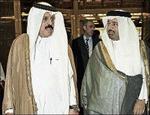
Secretary general of the Gulf Cooperation Council, Abdul Rahman al-Ateyah (left), arrives with Bahrain's Finance Minster Ahmad bin Khalifa, at the meeting of the Gulf Cooperation Council finance ministers in the Saudi capital Riyadh, Saudi Arabia, yesterday.
RIAYDH, Saudi Arabia (AP):
Gulf Arab finance ministers said yesterday that strict monetary oversight in their nations has protected them from the global financial crisis, and voiced confidence in their continued ability to stave off the meltdown that has hammered world markets and stoked recession fears.
The ministers, representing six oil-rich Arab nations moving toward setting up a single currency by 2010, met in the Saudi capital in a bid to take stock of the impact of a financial crisis. The meeting came amid clear investor worries in their nations, despite repeated government assurances about abundant liquidity in the financial sector.
Buffering respective economies
The hastily convened meeting, ostensibly, was also aimed at determining if other, more coordinated, measures must be taken to buffer their respective economies.
The statement issued by the ministers and the governors of their respective nations' central banks said Gulf banks enjoy a "high degree" of liquidity and that government agencies will continue to monitor developments in the financial crisis.
The ministers "underlined their confidence in the stability of the monetary system in their countries" and the strength of their economies, said the statement. "It is expected that the economies of the Gulf Cooperation Council (GCC) countries will continue to grow by good averages."
Following the meeting, Qatar's finance minister, Youssef Hussein Kamal, told reporters that Gulf countries have "proved to the world that our laws and strict oversight are what saved us from the crisis the world is in".
"This gives (the world) reassurance to come and invest in our countries," said Kamal.
"We can cope with the impact of the international financial crisis with all the measures we have taken," he said, adding that the crisis will not affect the target date for forming a single currency in the region.
But in an indication of the concerns in a region where multibillion-dollar infrastructure projects are routinely announced, Saudi Finance Minister Ibrahim al-Assaf told the official Saudi Press Agency there were signs of a recession in developing countries that could directly or indirectly impact GCC economies.
Avoiding negative effects
"We should all work to avoid the negative effects and reduce their impact on our economies by coordinating policies and measures," he said.
Several analysts have said the GCC nations are well positioned to weather the brunt of the financial crisis - at least in the short-term - largely on the back of their massive oil-fueled cash surpluses.
Still, many of these nations have seen their local stock markets take a beating in tandem with broader global markets, drops that have been attributed to a range of factors, including panic selling, despite efforts by some of the central banks to pump more cash into the financial sector and lower interest rates.