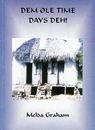
Title: Dem Ole Time Days Deh!
Author: Melda Graham
Reviewer: Barbara Nelson
"AS THE Jamaican society embraces modern science and technology, many of the customs that they embraced dearly are slowly going to the grave. Modern technology is responsible for tearing down and squeezing out many of our customs. Our children and young people need to be knowledgeable about some of the beliefs, traditions or customs that were practised and cherished by their roots."
This is the opinion of Melda Graham, expressed in the introduction to her second book, Dem Ole Time Days Deh! Graham is the English language and English literature teacher at Maggotty High School in St Elizabeth.
Aspects of life
The chapters describe various experiences of the Jamaica people - in childbirth, for example, in 'Mother and Baby' in 'Death and Burial', 'Transportation', 'Communication', 'Social Life, Work and Family Life', to 'Ole Time Wod', 'Jamaican Myths' and other aspects of life in 'ole time' Jamaica.
In 'Mother and Baby' the author describes the preparations made for a baby's birth, the role of the 'Grandie' or 'Nahna' who assisted the mother, the importance of the hot bush bath, the period of 'lying in' and the precautions that were taken to protect the health and well-being of the mother and the young child.
"Very little artificial food was bought for the baby. Babies depended on their mothers' breasts," Graham writes, but as the infant grew it was fed porridge made from grated green corn, and from the underground stems of arrow root and tuluma.
Graham says in 'Death and Burial' that in old time days there were no funeral parlours and when a person died his/her body had to be buried before the third day. That day was known as 'the raising night' and a special set-up was held on that night.
The inside of the coffin (made from sawn boards kept in the family's kitchen for that purpose) was cushioned with dry banana leaves or shaving from the board that made the coffin.
Various experience
Coffee (sometimes mixed with salt) was used in embalming the dead. With the introduction of the ice factory, however, people began to use blocks of ice to preserve the body until it was buried.
Among the many little-known customs that are brought to light in this chapter is that the clothes of the deceased were washed, hung outside and left there for nine days and nine nights. The clothes were then put away for three months and later given away to people who needed them.
In this chapter and 'The Balm Yard' the author describes the role of the obeah man, known as the 'Dealer', and the male leader (of the balm yard) the 'Pappie' and the female leader, the 'Madda', in the society of those days.
The chapters on Houses and Furniture, Food and Clothes are fascinating and, like the others, well researched. Most houses were small buildings with walls made of 'wattle and daub'. However, people in different parishes used whatever materials were available to build their houses. In Portland and St Thomas, for example, bamboo was the preferred material and cane leaves were used to cover the roofs. Red dye from logwood chips and wax from honeycomb were used to clean and enhance the floors.
Corn, cassava, yam, sweet potatoes, coco, dasheen and badu were the staple foods. In those days rice, flour and bread were rarely eaten, but gully beans or susumber cooked with salt fish and coconut milk "made a lovely dish." Annatto was used as food colouring and old rusty nails and green papaya used as meat tenderisers.
Average person's lifestyle
In bygone days in Jamaica most people did not own a lot of clothes and the average person had just one dressing suit. Men and women wore underwear made from brown or white calico. Washing clothes was very hard work and involved scalding the pieces in kerosene tins, using ashes, corn sticks and young ackee pods or brown soap to clean the garments. "All clothes were starched, including underwear," the author writes, and then proceeds to explain the tedious process of ironing - using irons that were made from pure iron (including the handles) and the various agents used to clean them.
Graham's book is a valuable addition to the information we now have on living conditions in Jamaica in years gone by. The book, however, can be greatly improved by better editing and using larger, clearer photographs.


















