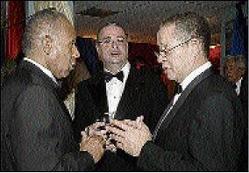
The big three (from left), prime ministers Patrick Manning of Trinidad and Tobago David Thompson of Barbados and Bruce Golding of Jamaica are seen here at the University of the West Indies' 60th anniversary banquet in Kingston in July. - File
Ever since the famous mathematical equation 'One from 10 leaves nought' signalled the collapse of the West Indian Federation in 1962, after Jamaica's pull out, there have been several attempts at forging closer unity among the countries of the Caribbean.
The demise of the federation led many of the more developed countries of the English-speaking Caribbean to seek their own socio-economic fortunes, first through political independence from Britain.
In 1966, Antigua and Barbuda, Dominica, Grenada, St Lucia, St Vincent and the Grenadines, Montserrat and St Kitts-Nevis agreed to establish their own grouping, the Organisation of Eastern Caribbean States (OECS), "highlighting a common determination to strengthen the links between themselves by uniting their efforts and resources and establishing and strengthening common institutions which would serve to increase their bargaining power as regards third countries or groupings of countries."
Maintained sovereignty
These countries have maintained sovereignty - each have membership in the wider Caricom grouping - but they share a central bank, a stock exchange, and a common currency.
In 1987, the OECS group decided to deepen their alliance in a political union, but acknowledged that the first step had to be "a process of comprehensive consultation within their countries, including a referendum on this matter before deciding on further appropriate steps."
The sub-regional leaders did not indicate the form of political union they were contemplating, and according to Earl Huntley, a former member of the now defunct St Lucia Independent Committee for OECS Political Unity, it had become increasingly apparent that until there had been concrete ideas regarding the form of the union, debates and consultations on the merits would be handicapped.
The referendum was never held, but, according to a paper put out by the St Lucia-based OECS Secretariat in 1988, "the quest for union was never abandoned for it was always acknowledged that the formation of a political union would be the catalyst for the widest economic and social development of the Eastern Caribbean."
The OECS countries have survived as a bloc, some of its members still pressing for relations to move to the next level.
'Ramshackle apparatus'
After 35 years, said Dr Ralph Gonsalves, the Prime Minister of St Vincent and the Grenadines, CARICOM remains a "ramshackle political-administrative apparatus" that allows several of its member states to "jealously guard a vaunted and pristine sovereignty."
Now, three OECS countries - St Lucia, St Vincent and the Grenadines and Grenada - at a mid-August summit in Port-of-Spain, have joined the oil-rich twin island republic of Trinidad and Tobago in signing a memorandum of understanding indicating their intent to proceed to "an appropriate political integration by 2013".
"There will always be those who will say 'we have had deadlines before' but I am sure you will also know that it is clearly for the first time in a long time we have leaders in the Caribbean who are prepared to commit to political integration as opposed to anything else," said Trinidadian Prime Minister Patrick Manning.
This is not Manning's first attempt at political union.
In 1992, Manning was pushing for closer cooperation with Barbados and Guyana that could lead to a political union without prejudice to the other CARICOM states.
In 2003, following talks with the then Barbados Prime Minister Owen Arthur and Gonsalves, Manning described the deliberation as laying the foundation for political union, while Gonsalves spoke of political unity with any three or more countries starting with a confederation.
Addressing the recent convention of his ruling People's National Movement (PNM) Manning said the twin island republic could not ignore the thrust by the sub-region to deepen their union.
Not designed to undermine
The Port-of-Spain mini-summit that was also attended not by the leaders but the foreign ministers of Guyana and Barbados, underscored that the new initiative was not designed to "undermine the single market or economic cohesion established by the Revised Treaty of Chaguaramas" which governs the 15-member CARICOM grouping.
They made it clear that participation in this new venture is open to all member states wishing to commit to the achievement of the single economy by 2011 and the political integration two years later.
Free movement
The single economy is part of the wider CARICOM Single Market and Economy (CSME) that would facilitate the free movement of goods, services, and labour across the region.
The CSE is due to come on stream by 2015 and at least one top regional public servant regards the new Port-of-Spain initiative as "speeding up the process".
Gonsalves said that it was the judgement of the OECS leaders "that it is unlikely we would reach the single economy by 2015 or if we reach it we would not reach it in a manner sufficiently advantageous to the countries of the OECS."
Based on that assumption, the sub-regional grouping decided, he said, "to fashion an OECS economic union by 2009 and we want to see other countries involved."
Academic and former St Lucian prime minister Professor Vaughan Lewis as well as Trinidadian diplomat Dr Cuthbert Joseph have been commissioned by the leaders to prepare a study on the modalities or steps to be taken to achieve their union.
"And until such time as the report is received, then really it would be premature to be talking about the exact form it will take and so on," Manning said.
But the leaders have already agreed that the new venture would require new governance arrangements, implying also some ceding of elements of individual sovereignty. They acknowledge that it would be considered a "challenge to some countries."
Weaken the group
Jamaica has not exactly said it's a bad idea, but is on record with its concern that such an alliance could undermine the integration project within Caricom, and possibly weaken the group, and that joining with Manning and the OECS was out of the question.
PM Bruce Golding wants the issue discussed and its implications assessed at a meeting of the Caricom heads of government, where some local foreign trade commentators have said it should have been raised by the parties in the first place.
The joint communiqué issued at the end of the Port-of-Spain talks noted the need for the new initiative to be ratified by the respective Cabinets of the countries involved, by the end of the year.
"Basically it is an undertaking to proceed with and through consultation to be able by the end of 2008 to make a full commitment to the process," said St Lucia's Prime Minister Stephenson King. "For those of us in the region who have been talking about regional integration for decades ... I think this one can be yet another stream of movement."
The newly elected Grenada Prime Minister, Tillman Thomas, whose participation in the talks here coincided with a two-day official visit to Trinidad, said it was necessary for the regional leaders to start thinking about the concerns of their population who have been clamouring for closer unity over the years.
"If we are really concerned about the people, we should be willing to relinquish a certain amount of sovereignty in the interest of the political unity of the region," he said, adding, "I believe we should work towards that deadline and set out to educate our people so that whatever structure that is more appropriate for that political union we should really try to give it support."
Slipshod
Manning has said that he does not need a special majority in the Parliament to give effect to the new initiative, but Opposition Leader Basdeo Panday has criticised Manning's handling of the matter as slipshod and slammed him for committing Trinidad "to certain agreements with three of our CARICOM neighbours without having first consulted the people and received their agreement and consent."
He added: "In fact, such a serious matter as political integration should have been the subject of a referendum."
- CMC and Gleaner reports