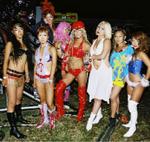
Contributed
Japanese contestants at last year's Dancehall Queen contest in Montego Bay, St James.Krista Henry, Staff Reporter
Taking a musical pilgrimage each year, many Japanese nationals travel to Jamaica, the motherland of reggae and dancehall.
With an almost fanatical interest in the culture Japanese visitors eat, sleep and drink in everything Jamaican.
In the last 15 years, according to the website of the Embassy of Jamaica in Tokyo, over 100,000 Japanese travellers have visited Jamaica not only for sightseeing but reggae and reggae concerts. And as of October 2005, 183 Japanese nationals were residing in Jamaica.
Dancehall designs
Late-night visits to the street dances, eccentrically dressed to imitate Jamaican dancehall designs, is now a norm for Japanese visitors.
Today reggae music is a multi-million dollar industry in Japan, with Jamaican musicians in demand, in high demand. Artistes such as, Voicemail, Ce'Cile, Beenie Man and Tony Matterhorn are almost a yearly fixture in Japan, with many Jamaican artistes releasing albums exclusively in that country.
Recently rising artiste Craig 'Serani' Marsh signed a two-album deal with Japanese label JVC Entertainment. The first album, entitled Serani - The Future, will be released exclusively in Japan shortly. Dancehall duo RDX has signed with Universal Music Japan. The one-album deal, with possible options, was recently sealed by the duo's publishing company Jamdown Music.
Japan has even 'bussed' artistes in Japan before they were stars in Jamaica. In 2005 Sojah Brothers had their big break in Japan after recording the single titled Pon Di Corner.
Japanese reggae charts
The song was in the top five positions on various Japanese reggae charts for most of 2005 and this led to the duo travelling to Japan for the first time. In 2006 they released their debut album in Japan, entitled Sons of Jah, which earned them a successful four-week tour through various Japanese cities.
Selector Cutty from Coppershot Disco also scored a smash number one hit song in Japan with The Japanese Dance or Sanano Kan Kane.
The Japanese have buried themselves in reggae culture. According to Kevin of Voicemail the group has performed in Japan more times than he can remember and the trio always receives a lot of love. "Di love Japanese people have for Jamaican music, it's overwhelming. It feels like there's no other music. They listen to hip-hop and Rn'B, but not like dancehall and reggae," he said.
Over the years Japan's obsession with Jamaica has slowly changed. Whereas one time travelling to Jamaica was necessary to keep current with the music, now Japan has copied all aspects of reggae/dancehall culture. Tomoko Uemura, a Japanese language teacher at the Language Training Centre, not only teaches Japanese but also assists in passing on information about reggae music to promoters in Japan.
Underground
She explained to The Sunday Gleaner that "in the 1980s roots reggae music was very popular in Japan with Bob Marley, but it was underground. Now, however, reggae music has gotten very popular. The reggae scene has changed in Japan. Whereas one time Japanese people asked reggae artistes to pass through to perform now there are more Japanese musicians doing more reggae music. There is a better mix between Japan and Jamaica."
In addition, Japan has in effect replicated all the popular Jamaican sessions, from Bembe to Passa Passa. And not only are there Japanese reggae artistes but there are also many sound systems, such as the famous Mighty Crown, which this year beat out Jamaican sound systems for the coveted Death Before Dishonour title the second year running. Then there is Junko, the limber Japanese women who took a Dancehall Queen title. The owner of the popular Yumi Hi-Power car sound system is Japanese.
Reggae clubs
Of course, all this is aside from the reggae clubs and festivals in Japan.
While Kevin has not visited the Japanese versions of street dances he has visited the reggae clubs, which he says feels like being at a club in Jamaica. "There are very current when it comes to the music," he said.
The website of the Japanese Embassy in Jamaica, www.jamaica.emb-japan.go.jp, stated that "one very popular reggae festival is the 'Reggae Japansplash'. This reggae festival first appeared in 1985 and has over the years welcomed some of reggae's brightest and upcoming stars to Japan. One of the most recent Japan-Jamaica cultural events held in Japan was the 'One Love Jamaica Festival', held in late May at the city's famous Yoyogi Park, Tokyo, to celebrate the 40th years of diplomatic relations between Jamaica and Japan".
Kevin says there is just something about Jamaican culture and music that persons can relate to, no matter the language and area. And as long as Jamaican music continues to grow there will always be one love from Japan to Jamaica.


















