Byron Buckley, Associate Editor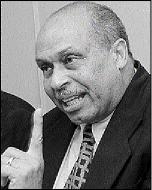
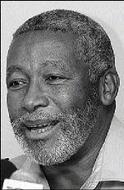
Miller (left) and Admiral Lewin (right)
Democracy triumphed in Jamaica in 2007. For the 16th time since the advent of Universal Adult Suffrage in 1944, on September 3 this year, the electorate effortlessly selected a new government. A nuh nutten.
Indeed, Bruce Golding's swearing-in on September 11 as the country's eighth Prime Minister (the head of government was called 'premier' prior to Independence in 1962) brought to closure a process of transition that began with P.J. Patterson passing the prime ministerial baton to Portia Simpson Miller on March 30, 2006. Simpson Miller, wanting her own mandate from the electorate, called a general election. Instead, the people gave the mandate to Golding.
So, within 18 months, Jamaica demonstrated her political maturity by changing prime ministers twice. No sweat.
There was no constitutional crisis, no aborted coup d'état. Take a bow fellow Jamaicans! It was symbolic of our political maturity that three former prime ministers - Simpson Miller, Patterson and Seaga - were all in attendance at Golding's inauguration.
The electorate's political sophistication was reflected in the nature of the mandate they gave Golding's Jamaica Labour Party (JLP) - a 3,000 difference in popular votes in favour of the latter, and a four-seat majority in the legislature. The mandate could be interpreted as a change of management, but no fundamental change of politico-economic policies, despite the JLP's appeal to the electorate to "change course". Simpson Miller's claim that she personified change rang hollow because months earlier, she had filled her Cabinet with old faces from the Patterson era.
National polls
Furthermore, electoral statistics indicate that some 40 per cent of eligible electors did not participate in the national polls. They, likely, had doubts about the capability of both contenders for the position of Prime Minister. So, at best, it seems the electorate gave the Bruce Golding-led government a qualified mandate: Govern along the lines of consensus.
Based on his election victory speech and his inaugural address as Prime Minister, Golding seemed to have initially grasped the need for governing by consensus, but his subsequent actions have detracted from this.
The management of the electoral process in 2007 is also cause to be proud, despite some glaring administrative mishaps during the conduct of the general election. However, the steady hands and steely will of electoral officials led by Professor Errol Miller kept the electoral locomotive on track. Successive administrations and Oppositions must be commended for the work done to continuously reform the electoral system to the point where the Electoral Commission of Jamaica (ECJ) was born this year. This culminated in a bipartisan process initiated 30 years ago by then Prime Minister Michael Manley and Opposition Leader Edward Seaga.
But in its infancy, the ECJ could have been mortally wounded. Following the passage of Hurricane Dean, which caused the postponement of the general election on August 27, the ECJ advised then Prime Minister Portia Simpson Miller of a timeframe in which to reschedule the parliamentary elections. Simpson Miller, faced with the urgent need to implement a hurricane-relief programme, wanted to disregard the advice of the ECJ.
But, apparently having been persuaded by other Cabinet colleagues to maintain the integrity of the electoral process and the role of the ECJ, she resisted the temptation and called the election for a date that turned out to be inimical to her political fortunes. Opinion polls subsequently showed that disaffection with the pace of hurricane relief adversely affected Simpson Miller and her People's National Party (PNP) chances in the September 3 general election.
An aspect of electoral management that needs improvement in the coming years is the role of the Political Ombudsman. As our democracy matures, this office needs to be given the authority to apply and enforce sanctions on delinquent political combatants. Notwithstanding, the incumbent ombudsman, Bishop Herro Blair, has continued to referee the electoral contest with satisfactory results.
Unwittingly, Prime Minister Golding's quarrel with the Public Service Commission (PSC) over its selection of Professor Stephen Vasciannie - Golding's detractor in the past - as the Solicitor General, is testing the mettle of Jamaica's constitution-based democracy. The imbroglio has put squarely on the national agenda the issue of constitutional reform, about which we have been vacillating for 30 years. The framers of the country's 45-years-old Constitution thought it prudent to insulate the appointment of senior civil servants from direct political influence, hence the establishment of various service commissions which report to the Governor-General.
Fierce debate
But, during the fierce debate prompted by Golding's refusal to accept the PSC's decision, a strong argument has emerged in favour of the Prime Minister having the final say in the selection of a sensitive and senior position such as the Solicitor General. Is the old arrangement by the framers of the Constitution proving to be a fetter to a prime minister in modern times? Has Golding, now that he is Prime Minister, developed a real appreciation for the power of the office, which in the past, he wanted reduced or checked?
As proof of our maturity as a functioning democracy, the judiciary has been asked to rule on the matter. When this is concluded in the New Year, our system of government would have benefited from a court ruling on a fundamental issue. The country can only benefit from this. Another approach could have been adopted in seeking to address the issue, in the form of street protests as occurred in Pakistan because of a disagreement between the President and the Chief Justice.
Murderous blood feuds
While our democracy has flourished in electoral and constitutional terms, there is a dark underbelly to the national life: There are murderous blood feuds among groups in communities, some demarcated by political allegiance. Even where there is no inter-community rivalry, these political enclaves serve as hideouts for criminals and their nefarious activities. While there are criminal elements elsewhere in society, the job of the police would be made much easier if these crime bases were neutralised.
In the coming year, civil society and newly installed Police Commissioner Rear Admiral Hardley Lewin must put tremendous pressure on the political leadership at all levels to reform or expose malcontents in their constituents. Let the process start in the constituencies of the Prime Minister and the Leader of Opposition.


















