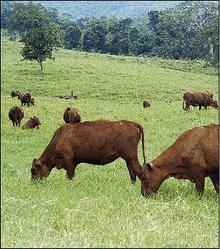
Cattle grazing on the 330-acre Grier House Farm owned by Dr. Henry Rainford, managing director of the Jamaica Livestock Association Limited. Reduced cattle inventory has resulted in a fall in demand for animal feeds, forcing the JLA to diversify its retail products. - File
John Myers Jr., Business Reporter
The Jamaica Livestock Association Limited (JLA) is investing $50 million to diversify its product offerings at its Savanna-la-Mar, Westmoreland store, saying it would be modelled off the operation at Linstead.
The JLA has a wider plan to transform its retail operations into a series of 'super stores', or a one-stop shopping centre for farmers, to boost revenues.
"We have an example in Linstead where we have a hardware store selling lumber, steel, cement and that's doing fairly well and I think we can move that into our other stores islandwide," Rainford said.
The expansion of the Sav-la-mar store, one of a chain of 13, is expected to be carried out next year.
Alongside the traditional supplies of animal feed, the refashioned stores will sell hardware supplies, equipment, and farming accessories.
While noting that the new concept would not be easy to operationalise, JLA managing director and principal shareholder Henry Rainford said the market does exist and that it was just a matter of leveraging the JLA's existing network of stores to entice business.
Merchandise is the company's biggest money spinner, followed by animal feeds and poultry.
But it was feeds that topped earnings for the first half of 2007, accounting for $371 million of $633 million or 58.6 per cent of gross revenues in the first six months to May 2007.
In addition to their regular agricultural supplies, farmers also "need housing supplies, nails, and lumber," said Rainford.
"I think that it is a tough business, but because we have the stores islandwide we want to let farmers know that not only do they buy the herbicides, pesticides, fungicides, animal feeds, but they can also buy their building material," he told Wednesday Business.
The JLA's profits are currently on a down slope with net losses of $857,000 in its first six months to May 2007.
Higher grain prices have hammered a huge dent in the company's operating revenues. For example, in the last quarter, March to May, the company's cost of sales rose to $238 million compared to $178.6 million in the comparative 2006 quarter.
For the six month period, cost of sales were almost $90 million higher at $447.6 million.
The world market price of corn and soybean - key ingredients in the manufacture of animal feeds - have risen more than 100 per cent, Rainford said.
The price for wheat middling, another ingredient and which is sourced locally from Jamaica Flour Mills, has more than doubled over the same period.
In the case of corn, the JLA head said the price had moved from about US$100 per metric tonne last year to over US$200. Soybean price jumped from about US$240 per metric tonne last year to over US$300 currently.
Wheat middling, which is combined with corn and soybean to make animal feeds, has moved from J$5,000 per metric tonne to about J$11,000.
The increased prices have been eaten into profits since last year when the JLA recorded pre-tax losses of $12 million.
Additionally, the demand for animal feeds has declined alongside the cattle herds in inventory: 50,000 heads now compared to 350,000 heads a decade ago.
"We are geared to servicing that industry so there is less demand for my products: medication, feeds, equipment and all the services that the beef and dairy industries use," said JLA head.
"We have to diversify."
john.myers@gleanerjm.com


















