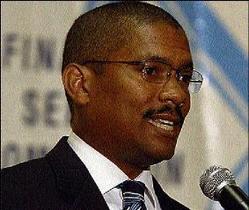
George Roper, deputy executive director in charge of secuirties at the Financial Services Commission, says the regualtor is still gathering and reviewing information to determine whether September trades by executives at Jamaica Broilers could be considered insider trading - File
The Financial Services Commission (FSC) said Monday it was still investigating the case involving Jamaica Broilers, making it "improper to speak" on the circumstances of the trades made by seniors managers days before the company reported expected financial losses.
"We are still gathering and reviewing pertinent information on this matter," said George Roper, deputy executive director, whose portfolio covers the securities sector.
Broilers executives met with the financial regulator last week and have reported that the talks were amicable.
No confirmation
Roper would not confirm nor deny the direction of the talks, nor did he say how long the investigation would be.
He signalled, however, that the probe under way centred on whether there had been a breach of fiduciary duty.
"It should be noted that the trading in shares by insiders is not illegal, per se," said Roper.
"Trading by insiders is only illegal if there is a breach of fiduciary duty because the insider has information, not available to the public, which is price sensitive, and is therefore able to secure an advantage for himself at the expense of the shareholders whose interest he is contracted to be mindful of."
The listed company has already been cleared of improprieties by the Jamaica Stock Exchange (JSE), regulator of the stock market.
Broilers also met with the JSE last week after trades by two vice-presidents, Don Patterson and David Mair, were recorded one to three days ahead of a September 28 profit-warning notice, saying the poultry producer was expecting a US$3 million loss on its three-month-old ethanol operations.
Breached contract
The losses were related to a breached contract.
Last Thursday, however, the company advised it had negotiated US$1.45 million of compensation from its suppliers, saying it would stem some of the bleeding.
The FSC's findings, if insider trading is deemed to have occurred, will be passed on to the Director of Public Prosecutions for action, said Roper.
Insider trading is punishable under the Securities Act by fine for companies, and fine or up to 10 years' imprisonment for individuals. The fine is not specified.
The law also allows for convicted insiders to pay civil remedies, and gives shareholders three years from the date of the transaction to bring action.
"Section 53 of the act provides that persons convicted under Section 52 are liable to pay compensation to any person who suffers loss," said Roper, "by reason of the difference between the price at which securities were dealt in, in an improper transaction - such as an illegal insider trade - and the price at which they would likely have been dealt in, in a similar transaction at the time."
business@gleanerjm.com


















