Heather Little-White, Ph.D., Contributor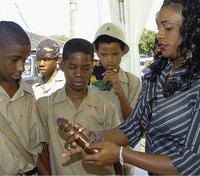
Simone Braithwaite (right) of Femidom, distributors of the female condom, shows some attentive schoolboys the proper way to put on a condom during the Safer Sex Exposition at Devon House on February 16, 2006. The exposition was a part of the activities for Safer Sex Week staged by the National HIV/STI Control Programme.- Rudolph Brown/Chief Photographer
Sex education is more than the 'birds and bees', but today several young people have hardly moved beyond that knowledge of their sexuality. Young people face many challenges as they pass through puberty and face explicit media messages on sex and with little or no parenting support. Based on the increase in the number of children having first sex at an earlier age, the increase in child and teenage pregnancy, as well as HIV/AIDS and other sexually transmitted infections (STIs), children and teenagers are in need of help.
The objective of traditional faith-based sex education programmes is to encourage young people to delay sex until they can become sexually active inside a faithful marital situation and be blissfully happy. Any other activity outside this objective that is not addressed can result in harm, not only to the individual, but also to families and society as a whole. Traditional programmes stress the spiritual and health benefits of abstinence and secondary virginity (teens who suspend sexual activity), and the physical and emotional danger of an active sex life outside of marriage.
Strengthen values
The reality, though, is that sex education programmes in schools today must stress an open relationship between parents, other elders and children. Sex education programmes must strengthen values and improve the self-worth of children as they develop into adults. Children and teenagers should be empowered to resist peer pressure to become sexually active and use drugs (sex and drug use are frequently equated).
Presentations and the materials used to foster a more liberal approach to sex education should not be one-sided. The physical side of sex should be explained in a way that addresses the emotions and pleasure sexuality elicits and what feelings are experienced during sexual interaction. Abstinence or sex within marriage are presented as the only forms of safe sex and effective birth control without adding other forms of pleasurable activity.
Homosexuality
Gender roles and dual career partners should be discussed to determine their impact on union/family dynamics. Homosexuality and other sexual orientation should be discussed outside the topic on HIV/AIDS. The possibility that there is a broad range of 'normal' human sexual behaviour, or that families can come in many forms is never considered.
Sex education should not use religious bias to develop a fear- and shame-based approach to sex education. The result is that children and teenagers grow to fear their sexuality, reinforce gender stereotypes and deliver misinformation on condoms and other contraceptives. They also use misinformation about AIDS/HIV to reinforce homophobic bias and refer to AIDS as nature's way of punishing for some kind of sexual behaviour. Inadequate and inaccurate medical information, such as equating pre-marital sex with increased incidence of cervical cancer, is misleading. Further, sex education programmes fail because materials and information are outdated, teachers lack training in sex education and lack objective information about sexand sex education.
The way forward
School principals can take the lead and increase their knowledge of and involvement in sex. They can apprise themselves of programmes that provide accurate age-appropriate information for children, parents and the community.
Sex educators should be used or teachers be trained in recent information of sexuality to include sexual decision making, the emotional consequences of sex, abstinence and sexually transmitted infections.
Schools need to solicit the support of parents and community to be successful in implementing sex education programmes. Sex education begins at home, but several parents do not know what to impart or are uncomfortable in communicating with their children about sex. Parents should be encouraged to talk about sex with their children at an early age.
Survey parents in the community to get their views on what they think about sex education and ask for their input.
Schools should be prepared for objections from parents who view sex education as encouraging their children to have sex, and that it is a subject that should only be discussed at home.
Provide parents with current facts about the sex experimentation that takes place among schoolchildren.
Educate parents by providing a resource centre with books, pamphlets and supplies so that they can review these and discuss with their children. Include an expert on sex education to address parent-teacher associations and health fairs.
Link the school with community agencies and social services that have the objective of promoting good heath for young people.
Sex education in schools should be compulsory. This would ensure that children, parents and community members be exposed to accurate sex education to counteract some of the negative behaviour associated with children's sexuality. Children should be able discern the stirrings of hormonal changes in the body and feel comfortable to discuss these changes with parents, guardians or community leaders.


















