
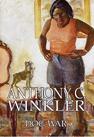
Mary Hanna - ContributedTitle: Dog War
Author: Anthony Winkle
Reviewed by: Mary Hanna
Publishers: Oxford: MacMillan
Caribbean, 2006. 194 pages.
Fast-paced and light-hearted, this short novel fits readily into veteran storyteller Anthony Winkler's works to date. It is redolent with his signature humour, bringing a perceptive eye to the challenges of widowhood and emigration.
Winkler speaks to us through the persona of Precious Higginson, a middle-class Jamaican woman with a strong belief in the conventional world of Christian Jamaican life. When Precious' husband Theophilus dies in a traffic accident, she is left stranded in isolation in the mountains of Jamaica where Theophilus always dreamed of living.
Precious finds her world coming apart and agrees to migrate to live with her daughter Shirley, a policewoman in Miami. There Precious finds short respite, as her 'juiciness' proves too much for Shirley's husband Henry, and Precious must move on.
She becomes housekeeper ('dog maid') to a wealthy widow and her spoiled and pampered pet, Riccardo. She enters into a relationship with Mistress Lucy's chauffeur, Mannish Chaudhuri, whom she is determined to convert to her brand of Christianity. But before this can happen, Precious is attacked by the love-sick Riccardo who is determined to give her a good 'dog g ... '.
Winkler writes a hilarious climax that shows Precious's American world coming apart: she flees back to the mountains of Jamaica where a new order is set in place, with Precious the wiser for her travels. The story winds down to a satisfying if somewhat abrupt close with the juicy Precious being courted by the local pastor and reigning queen-like on her own verandah. Order is restored, and Precious continues to take her troubles to 'Jamaican Jesus' under her bed in long talks.
Precious exemplifies the morality and mentality of the good church-going Jamaican matron. She is appalled at the shiny American world she encounters and the indignities she must suffer as an immigrant. This is no Lucy through the eyes of Jamaica Kinkaid, but rather a rollicking romp through Miami from the point of view of a smart Jamaican woman who has a strong sense of right and wrong.
Precious 'remembered that Theophilus had told her that when he was in America, for one whole day all he could think about was, 'R..s, dis place big, you know!' and that even as he stood at a urinal he had found himself silently and obsessivelymuttering, 'R-ss, dis place big, you know!' over and over again. But that was Theophilus. He was willing to kowtow to geography. Precious, on the other hand, knew who she was and what she was and was determined that no amount of continental land mass or foreign spectacle would reduce her to spatial muttering in the toilet.'
Precious' special place is under the bed, where she is protected from tin cans dislodging themselves from where they have been thrown into trees and connecting with her head as a sign from God that she must do better. 'Lawd, I beg you, don't drop a tin can 'pon me head today!' is Precious's daily prayer, and the reason for her taking refuge under the bed. Her grandchildren appreciate this wisdom and join her companionably, but life gives Precious many licks anyway and she must take notice and find solutions to the challenges she meets as a Jamaican and an emigrant. Mannish keeps pointing out the 'culture difference' in every argument, but Precious is convinced she is in a mad place, made so by all the mad people there who don't realize that they are mad.
Mistress Lucy is the wealthy widow who owns the mansion where Precious works. She is a fanatic for animal rights, but turns out to have some odd secrets of her own in terms of her pet dogs. Precious is disgusted and glad to return to her native home. This is an emigrant's story with a difference, intertwined with satire and a witty expose of American values. It is the length of a novella and fully loaded with Winkler's comedic riffs told in his special vocabulary. For example:
'Theophilus had been just such a tough-skinned wretch: cantankerous, miserable, headstrong, set in his ways; always trying to shish kebab with everlasting pushy, forward, impertinent, rude, and out of order bamboo; always bawling about his dinner, complaining about his clothes, ranting and raving at maid and mistress. If ever a man had gone straight to heaven it was that gluttonous, never-satisfy, big-belly soul, and Precious just lamented the day the wretch had togo and collide with a truck around a corner, stranding her in America with a too-too man for company.'
The 'too-too' white American is one who cooks and caters to his woman, throwing things out of order and usurping the place of woman who knows how to look after herself and her man, too. Winkler draws a gorgeously satirical portrait of an upside down marriage in Precious's eyes, with her daughter Shirley as the policeman and her husband Henry as the hairdresser and housekeeper.
In Mistress Lucy's mansion, the dog Riccardo rules from his own bedroom and bed covered in cotton sheets with pictures of bones on it. But Riccardo takes a fancy to Precious and she finds herself fighting off the indignity of 'dog grind'. Winkler develops the situation with masterful ease and brings it to the climax that has Precious fleeing back to her mountain house in Jamaica, where Mistress Lucy finds her and brings matters to a peaceful close.
The story is somewhat thin but well told and full of humour and insightful witticisms about emigrant life and Jamaican widowhood. Winkler is to be commended on his ability to draw such a fine portrait of Precious Higginson, one that brings to mind his characterisation of Aloysius, the lunatic, in his hilarious novel of that name. Precious' story is less powerful because it is so dependent on the dog metaphor, but the narrative is wholly successful where it stays with realistic happenings - like Precious and her family sitting at a roadside curb in Miami so that the Jamaican grandma can fully experience the phenomenon of a white man digging a hole in the street as part of a construction gang.
Anthony C. Winkler was born in Kingston, Jamaica, in 1942, and attended school in Montego Bay and California. He is the author or co-author of many college textbooks on rhetoric and English grammar. Winkler's first novel, The Painted Canoe, was published in 1984 to critical acclaim. It was followed by The Lunatic (1987), The Great Yacht Race (1992), Going Home to Teach (1995), and The Duppy (1997). A short story collection, The Annihilation of Fish and Other Stories was published by MacMillan in 2004. He has written two plays and two film scripts. Winkler lives in Atlanta, Georgia.


















