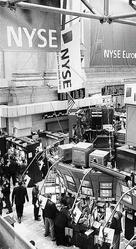
Traders work on the floor of the New York Stock Exchange on Tuesday. The Dow Jones industrial average swept past 14,000 for the first time after a relatively tame inflation report gave investors reason to continue a recent run-up that began in earnest last week. - AP The Dow Jones industrial average swept past 14,000 for the first time Tuesday after a relatively tame inflation report gave investors reason to extend an extraordinary, but questionable, Wall Street rally.
The stock market's best-known indicator crossed 14,000 in the first half-hour of trading and rose as high as 14,011.79, having taken just 57 trading days to make the trip from 13,000.
Stocks have risen fairly steadily since the spring amid a continuum of buyout news and evidence that despite higher fuel prices and the ongoing problems in the housing market and mortgage lending industry, consumers are spending and companies remain optimistic about the future.
With the Federal Reserve ever vigilant about inflation, any news that prices are rising at a moderate pace has added to the market's momentum, as it did Tuesday.
Upbeat earnings reports
The release of moderately upbeat earnings reports helped reassure a market that had worried that a slowing economy and rising energy prices would slash into corporate profits.
But the Dow's latest accomplishment does raise questions about whether investors are buying more on speculation than fundamentals.
A week ago, the average tumbled nearly 150 points after disappointing forecasts from Home Depot Inc, Sears Holdings Corp and homebuilder D.R. Horton Inc., but only two days later, the Dow barrelled 283 points higher as investors chose to put a positive spin on agenerally lacklustre series of retail sales reports.
"One of the things we know about the Dow being only 30 stocks is that it is a bit less representative of the entire market, but it is still a sign that large-cap multinationals continue to drive this market," said Peter Dunay, an investment strategist with New York-based Leeb Capital Management.
"For the moment, the momentum and strength is so good. You can't fight it."
In early afternoon trading, the Dow rose 38.78, or 0.28 per cent, to 13,989.76, slipping back from 14,000 with the normal ebb and flow of trading.
Dot-com boom
The short time that it took the Dow to pass this milestone recalls its ascent during the dot-com boom, especially because it took only 129 days to make the passage from 12,000 to 13,000.
In the late 1990s, the Dow took just 24 days to go from 10,000 to 11,000, and 89 days to go from 6,000 to 7,000.
The end of the high-tech boom plus the recession and the aftermath of the September 11, 2001, terror attacks helped send all the major market indexes into reverse.
It took the Dow 7 1/2 years to trek from 11,000 to 12,000, and only last October began setting its first record highs since January 2000.
Since then, the Dow has recorded 52 record closes.
Among the companies weighing in Tuesday, Coca-Cola saw its second-quarter profit rise one per cent as sales at the world's largest beverage maker rose 19 per cent. Case volume slipped two per cent in the company's key North America market, however. The stock fell 71 cents to US$53.14.
Merrill Lynch, the largest U.S. retail brokerage, said stronger investment banking results and fees from stock transactions boosted second-quarter profit 31 per cent from a year earlier. Merrill fell 74 cents to US$86.65.
- AP


















