
Gareth Manning and Garwin Davis, Sunday Gleaner Writers
Unable to find work and becoming more disillusioned by the day, young electors between the ages of 18-24 are less inclined to participate in the upcoming general election, according to a Gleaner-commissioned Bill Johnson poll.
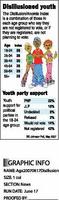
The findings of the pollster and his team in surveys conducted in early May, show that youth 18-24 years old make up close to 21 per cent of the population between 18-74 years old in Jamaica, they only comprise 12 per cent of registered voters.
Of this number, only 39 per cent say they are likely to vote in the general election constitutionally due in November.
"The remaining 61 per cent could be described as experiencing a combination of disillusionment and anomie," Johnson notes.
'Generation Y'
The surveys show that disillusionment peaked for the 18-24 age group in July last year and has remained high, with 61 per cent still feeling disillusioned in May when Johnson interviewed 1,008 residents across the island. The poll has a margin of error of plus or minus three per cent.
According to Johnson, these young voters, classified as 'Generation Y', could be the difference between winning and losing for both the governing People's National Party (PNP) and the Opposition Jamaica Labour Party (JLP), and "are out there for the taking."
Johnson believes Generation Y could well decide the election.
"We are talking about a group that at least 90per cent of them have never voted and are less likely to be allied to either the PNP or the JLP," he argues. "Both parties ought to be making a massive effort to reach young voters, because it's clear that those who do bother voting could determine the election's outcome. The challenge is to reach those that are likely to go to the polls but are still undecided on a party," says Johnson."
Although the expected voter turnout among young people appears low, the PNP seems to command a majority of the youth electors with 22 per cent support, compared to the JLP's 12 per cent.
Notwithstanding, the polls show declining support for the PNP, moving from 29 per cent in March last year to 22 per cent in May, while JLP support has remained relatively stable.
Support for the PNP hit its lowest in January this year at 16 per cent.
Political analyst and university lecturer Richard Crawford surmises that the young people might be turned off from voting because government policies over the years have not been in their favour.
"Opportunities for community development and training, oppor-tunities in education need to be improved, and that goes right across the board," he suggests.
He notes, for example, that while students might be able to get a student loan to finance their tertiary education, the application process is tedious and the interest rate is high.
Cynical
Crawford also posits that youths are shunning the polls because they do not believe politicians are serious about fixing the economic, social and political problems. He says young people are cynical because the government has repeatedly made promises it has not fulfilled.


















