
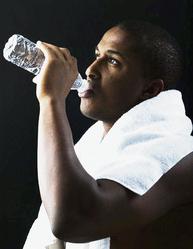
Eulalee Thompson Gulping down water from a bottle is a symbol of health consciousness, not only here in Jamaica but all around the world. In fact, a report in the National Geographic (Feb. 24, 2006) indicates that global consumption of bottled water doubled between 1999 and 2004, reaching 41 billion gallons (154 billion litres) annually.
But is bottled water really purer than tap water or is it just pure hype? The same report in National Geographic, pointing to report by the Earth Policy Institute, states that bottled water is often no healthier than tap water, but it can be 10,000 times more expensive. And, a four-year study by a United States-based agency, the Natural Resources Defense Council found that most of the tested waters were found to be of high quality, but some brands, about one-third of the waters tested, contained levels of contamination including synthetic organic chemicals, bacteria, and arsenic; in one case the contaminants exceeded industry standards.
Factories are registered
Here in Jamaica, the bottled water industry is monitored by the Bureau of Standards Jamaica (BSJ). Shernette Mccuth Henry, BSJ's Manager (Information) said that products are monitored at ports of entry, goods in the market place and food processing establishments for compliance under the Standards Act, Processed Food Act and the Weights and Measures Act.
In the case of packaged (bottled) water, factories manufacturing bottled water are monitored and registered after being assessed for:
General sanitation
Water
Screening of external openings
Suitability of equipment for proposed use
Self draining, impervious floors
Adequate lighting and ventilation
Impervious utensils and tables.
Bottled water tested
Mrs. Mccuth Henry also indicated that these factories must have in place suitable systems for quality control checks, proper documentation and record keeping and for coding individual products and cartons.
"Local establishments have been visited and their finished products tested; where results have been consistently unsatisfactory the bottling water line has been closed. In such situations, corrective measures would then have to be put in place to ensure the satisfactory processing of packaged water," said Mrs. Mccuth Henry in an response by email.
In cases where factories are not registered, the BSJ indicated that it will immediately remove relevant products from the market place.
Mrs. Mccuth Henry also pointed out that during the factory assessment process (mentioned earlier) and during domestic market monitoring, bottled water samples are taken by BSJ inspectors for microbiological tests - looking for various impurities.
"In our inspection of bottling water establishments ... we also verify the source of the water and whether or not the licence required from the Water Resources Authority for the abstraction and use of water from all surface or groundwater sources was obtained," Mccuth Henry said.
Labelling is also important and is monitored as bottled water is classified as spring (derived from an underground formation from which water flows naturally to the surface of the earth), natural mineral (where the level of the total dissolved material salts is greater that 250 ppm) or purified (potable water without inorganic substances). These definitions are based on theCaribbean Community Standard CCS 0048:2003.
Eulalee Thompson is a health journalist and psychologist; email: eulalee.thompson@gleanerjm.com.


















