
Improve your photography in 2007
Published: Sunday | January 28, 2007
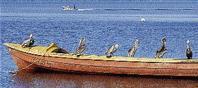
'Pelicans at Rest' - Kingston Harbour sets the backdrop for these brown pelicans as they rest on a fisherman's canoe on a lazy Sunday morning. - Photo by howard Moo Young
Whether you're a professional, amateur or snap-shooter, we all strive to take pictures that we can be proud of, and as photography becomes the greatest passion of many individuals, the new year is the perfect time to take stock of your work and assess your approach.
Whatever the level of photography you enjoy, take time to refocus on what you do and why you do it. For the next couple of weeks, I'll try to give you many tips, techniques and thinking that will help to improve your photography. Among some of the topics I'll cover will be:
Making use of natural light
Getting to know your subject
Which camera is right for you?
What makes a good picture?
Looking for pattern and texture
Thinking colour
Paying attention to detail
Telling a story
Adjusting your viewpoint
Read the manual
Many of you might have received cameras as gifts over the Christmas, or purchased new equipment, or upgraded your older models. Others might have added digital to their analog equipment. The most important thing you can do before trying to take any pictures with a new camera is to read the instruction manual.
All the technical information you need to know to maximise your camera's capabilities is contained within the camera's manual. Yes, it may be tedious and dull reading, but an hour or two spent experimenting with the manual sitting on your lap will certainly give you a better idea of what is or isn't possible. I am amazed to meet many individuals who just simply pass over the manual and start to fiddle with all the different buttons and controls, guessing as they go along. It's a waste of time, and also a waste of batteries.
Take control of your camera
Most beginning photographers let their camera make the decisions for them. We may be emotionally attached to our camera, but we should not let it control the whole picture-taking process. If you are still setting the dial to one of the automatic modes - portrait, landscapes, etc. - then it's about time you experiment and dabble in the satisfying world of creative control.
Remember that your camera is a hunk of metal and plastic with lots of internal electronics. While modern SLRs and even compacts are sophisticated state-of-the-art devices, they are of very little brain. They all do what the camera-makers have told them to do - i.e. select the smallest aperture possible for the Landscape mode, or the widest for the Portrait mode. However, if you want to get creative and really learn about the wonderful world of taking pictures, you can override the auto functions. Unlike your camera, you have a large brain capable of reason.
And if you're still not convinced, you won't find any camera on the market today with an automatic function called 'Composition' which will find and frame the best image and take the picture. This is left to you, so why leave any other part of the picture-taking process to an inanimate tool?
Learn to look and keep looking
You can find great images almost anywhere, so don't ignore opportunities that present themselves To spot good photographic subjects, you must learn to take a fresh look at things around you. You won't have to look far to find a good subject, but you have to become aware of light, form, shape and colour, all of which combine to make interesting images.
Even if you have planned a day in landscape photography and another opportunity should present itself, grab it. Be prepared to deviate from the day's plans if great photographs present themselves to you. The more you look, the more you'll see, and when you see it, shoot it!
Charge 'em up
Modern cameras - especially digital ones eat power at an alarming rate. Therefore it's imperative that you have spare batteries at the ready or rechargeables are fully powered up before heading off. There is nothing worse than finding your perfect photo only to have the camera die on you moments before you're about to press the shutter, take warning.
Visit an exhibition
There are two photography exhibitions you should miss. Take time out to visit "QUAKE", a black and white exhibition in commemoration of the tragic earthquake that destroyed 75% of the city of Kingston in 1907. It is mounted at the Institute of Jamaica in collaboration with the National Gallery of Jamaica, displaying images before and after the earthquake.
The other venue is the National Gallery of Jamaica, where the 2006 National Biennial Exhibition is mounted until March 10, 2007. The photography section of this show is a must-see for all photo enthusiasts, collectors and students with images done in various sizes by top Jamaican photographers. Take time out and view with an open mind.
Which format?
Don't assume that the camera should always be held horizontally because it is designed to be more comfortable that way. This is a common mistake made by beginners to photography. Use a vertical format if it compliments your subject's shape.
More tips next week!
Howard Moo Young, a graduate of the School of Visual Arts, New York, is an Advertising, Graphic Design and Photography consultant with over 40 years experience. Email: mooimages@yahoo.com