Audley Boyd, Assistant Sport Editor
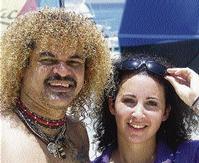
Anna Kharaanos (right), hotel ambassador, with Carlos Valderrama at Beaches Boscobel. - Contributed
The blondish-orange Afro practically glowing like a crown on his head makes Carlos Valderrama so easily recognisable. Only this time, the Colombian midfield king is not pulling the strings from the heart of the football pitch.
Yet, as he sits in wide open view on a beach chair perfectly shielded by the branches of one of the many short coconut trees in the white sand that welcomes the waves along the shoreline at Boscobel Beaches Hotel in Ocho Rios, it is not difficult to realise why he remained so outstanding in the hard game during his 22-year professional career. He is not afraid of attention and knows how to secure the precise vantage point.
One of his daughters, who is joined later in the interview by her sister, cousin and his wife, is right by his side, equally relaxed and composed in the manner always exuded by her dad in the seemingly effortless, yet tantalising displays that unquestionably singled him out as the greatest Colombian 'baller of his generation.
He has an easy-going attitude, which spurs instant affirmation for this Gleaner exclusive that was facilitated by Mexican Elisa Nava of the Boscobel Beaches Hotel's sales and marketing team, with an easy-flowing Spanish translation.
HUNG UP BOOTS
A two-time South American Footballer of the Year (1987, 1993), Valderrama hung up his boots for good in a tribute match with players like Enzo Francescoli (Uruguay), José Luis Chilavert (Paraguay) and Diego Maradona (Argentina) who could not play, at the Metropolitan Stadium in Barranquilla, Colombia.
"Now I'm on the link to football, running a football academy in Barranquilla and I'm also a businessman," he says.
His academy has been going for a year and it caters to youth aged seven to 18 years.
"I'm really, really happy. I actually enjoy it very much. I've always wanted to give back and I've always wanted to teach. I do it from the heart."
Valderrama captained Colombia at three World Cups - 1990, 1994 and 1998 - announcing his international retirement after the last.
JAMAICAN EXPERIENCE
He may be best remembered by Jamaicans for playing a practice international against the Reggae Boyz at the National Stadium, which Jamaica won 1-0 on a splendid strike from Ricardo 'Bibi' Gardner. In that game, apart from his passing, one might remember that Valderrama was also involved in a scuffle with the late Peter 'Jair' Cargill, the Jamaican midfield maestro.
He admitted difficulties tackling the Boyz and said though they have quality, they're lacking in structure.
"They have talented players. It was hard, it was complicated because they are fast players," Valderrama reminisced on that game.
Commenting further, he said: "Jamaican football lacks the same things as South American countries, organisation, they lack organisation. But they have really good players."
Since the match, this is his first visit to Jamaica.
"I've only been to Jamaica twice, the time I played against Jamaica and this time.
This time I'm really enjoying it. The first time, I never had time to go around Jamaica and enjoy the place. The first time it was just from the airport to the hotel then to the field then back to the hotel, airport and out.
"This time I've had the time to go around and see what Jamaica is about. I've actually been able to enjoy it this time."
CAREER
Throughout his career, Valderrama represented many clubs in several different countries. He started at Colombian first division side Union Magdalena in 1981, then moved on to Millonarios and Deportivo Cali. As his reputation grew, overseas interests swelled and he went to France in 1988, where he almost won instant success at Montpellier, winning the French Cup two seasons later. Soon he made another move, a short one, on the European continent to Spain at Real Valladolid in 1990.
In 1992 he went back home and played first with Independiente Medellin, then Atlético (Barranquilla) Juniors where he twice won the Colombian Championship (1993, 1995). The United States Major League Soccer (MLS) was the stage for much of his career from 1996 when he played for Tampa Bay Mutiny (1996-97, 2000-01), Miami Fusion (1998-99) and Colorado Rapids (2001-02).
Valderrama scored only 16 goals in his MLS career, but dished out a remarkable 114 assists, perfectly summing up his reputation as one of the best passers of the ball the game has ever seen. It made him the MLS All-Time Assist King, earned him the MLS Player-of-the-Year. Award in 1996 and in 2005 he was named on an All-Time Best MLS XI. Also, he's a member of the FIFA Century Club and was the only Colombian listed by FIFA in its top 125 living footballers in 2004.
Besides passing, one of his amazing qualities was manifested through the way he controlled matches at what was really walking pace.
It appears simple but Valderrama admits he was only able to do that "by training."
"That was my personal characteristic. Every footballer has their personal characteristic but training contributed mainly to that," he admits.
Asked about his most feared opponent, Valderrama said: "I never feared. There was never fear but always respect for the other teams. But I always think about my team, not another team."
MARADONA OR PELE?
And he thinks Maradona is the best.
"Diego Maradona. He's the best player I've ever seen."
Making the straight-up choice against Pele, he added: "Maradona. I always saw Maradona playing; I only saw Pele play one World Cup, in 1970. I saw Maradona play all the way through his career."
He lists the 1990 World Cup in Italy and a draw with the eventual champions among his most memorable moments on the pitch.
"The most special moment in the World Cup was the tie with Germany. We were the only team to tie with Germany at that World Cup," he said.
With the likes of Carlos Asprilla and Fredy Rincón, Colombia were among the favourites and easily one of the most enterprising at that competition. But he wasn't disappointed they never won.
"We were not disappointed, we played as well as we could."
He added: "In football you win, you tie and you lose but we were very happy with the performance we had in that World Cup. We played as best as we could."
One of his most difficult moments came with the shooting death of fellow teammate Andrés Escobar, who had scored an own goal against his team at the World Cup. He was shot on his return from the World Cup in Colombia.
"It was a really hard time both individually and as a country because of the situation because it was something that never happened before. It's not something that's common. It had never happened before and it has never happened again," Valderrama explained.
"It was a really, really hard time. It was a shocking moment but players were still willing to represent the country; they never stopped. It's something that has to be overcome. It affected not only the players and the country but the whole world, it actually shocked the whole world but it's a moment that has to be overcome."
Another low occurred during his brief stint representing Real Valladolid in Spain's La Liga.
"One of my lowest points was when I was in Spain. The team was not well organised. They were having problems with the pay. It was a rough year but we worked hard to overcome that step."
WORLD CUP
On the just-concluded World Cup, Valderrama, nicknamed "El Pibe" (The Kid) off a former Argentine player named Pibe, said he was backing Argentina and Brazil but poor play and changes ended their chances.
"Argentina and Brazil were my favourite teams. Brazil played really bad and Argentina, they were playing well but their main problem was the changes that they made. They played well but the changes were wrong."
He also had a word for Ecuador.
"Ecuador played really, really well. They represented South America really well; their tactics were good."
Like the Escobar killing, the Zinedine Zidane head-butting of Italy's Marco Materazzi in the final sent shock waves across the world. Like his former teammate, Valderrama was sympathetic towards the Frenchman.
"Something was said to him that made him do that. He's a very calm player, usually he plays very calmly. It must have been something really bad to him to make him act like that."
In a World Cup final?
"He's a human being," Valderrama noted. "Everybody has to make themselves get respect, no matter if it's your first or last game or what kind of game it is."
The Colombian star knows all about getting one's due, having commanded so much respect on and off the field.
A number of former stars on the pitch have taken the coaching route since the end of their playing careers but Valderrama says he won't follow suit, at least not now.
"No, no, no," he answered the query. "I wouldn't go into international or national coaching right now. It's a full-time job; it takes a lot of time and dedication.
"I'm really happy with the academy now and working with the kids and I feel it's time to be with my family. I've already dedicated a lot of time to football professionally and I feel it's time to dedicate myself to my family," pointed out the father of six. "It's not because of the capacity (coaching) but it's a full-time job."
The king of passing with the blondish-orange Afro is clearly at ease with his new dispensation: Imparting football skills to Colombia's youth, enjoying Jamaica's warmth, his family and life on the beach.