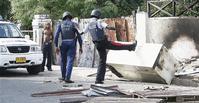
Police clear debris from Charles Street, downtown Kingston, on January 3, 2005, after residents blocked the roadway to protest an alleged police shooting of a 14-year-old. According to Jamaicans For Justice, the island recorded over 200 police killings in 2005, the highest rate of police homicides here in 15 years. - Photo by Fabian Ledgister
Jamaicans For Justice (JFJ), like all Jamaicans, is heartened by the success being enjoyed by the police in reducing the country's appalling murder rate. Comparing murder rates for 2005 and 2006, the murder rate is down by about 20 per cent to the end of May.
This would seem to speak of the effectiveness of the new strategy of community-based, intelligence-led policing put in place by the commissioner and his staff, and they are to be commended for their hard work.
At the same time, JFJ is very concerned at the increase in the number of fatal shootings by the police over the same period. In 2005, Jamaica recorded over 200 police killings, the highest rate of police homicides in 15 years. This year, over 80 people have been fatally shot by the police - 25 persons in the month of May alone. These statistics are alarming, particularly as the circumstances are questionable in many of these shootings. This is a stain on the operations of the Jamaican Constabulary Force, and is absolutely unacceptable.
Excuses
It can be very easy to distance oneself from these statistics and make nonsensical and barbaric statements such as "Criminals who break into our houses and slash the throats of our children are not 'human' in the sense of the definition. They have no rights. They are rabid animals, which must be 'put to sleep'," as a letter writer to The Gleaner so indefensibly put it. Those who are less extreme make excuses such as "unless you know the hardship a policeman/woman faces in his/her day-to-day job" and "it is not easy being a policeman/woman" working in dangerous circumstances facing hardened criminals every day, usually followed by the qualifier "[t]his is not to say there aren't a few bad eggs in the force."
The Jamaica Constabulary Force (JCF)does work under very dangerous and difficult conditions a lot of the time. Some of their difficulties have been created by the society's persistent undervaluing of what they do, as evidenced by the persistent failure to provide the force with sufficient manpower and technological resources.
'Bad eggs' are in danger of spoiling the entire force by their influence on their colleagues, the impunity that their actions enjoy, and the support they receive from those in society who should know better.
However, it is much more difficult to do this distancing when faces are put to numbers and society is forced to confront the fact that most of the persons killed by police are innocent not having been proved guilty, often victims twice over, victimised by the illegal actions of members of the JCF and then victimised by the silence and collusion of their killer's colleagues who cover for them and their illegal activities.
THE STORY OF CHRISTOPHER MCKENZIE
At approximately 10:30 p.m. on March 2, 2005, the day before he was due to return to his mother in America, Christopher McKenzie was killed at Crofts Hill Police Station.
McKenzie, about to celebrate his 18th birthday, had for the last three years lived in America with his mother and younger sister, and was visiting Jamaica to spend time with his father and grandmother before returning to the U.S. to start college.
The precise circumstances surrounding his death remain a mystery, including any explanation of how he was so severely beaten as shown on autopsy.
Both the Government autopsy and the report of the independent observer
representing the family at the post-mortem showed that Christopher was severely beaten, including having bruises and scrapes all over his body, and cuts and bruises on his face and head, before being shot twice, once in his back - exiting through the abdomen - and once in the back of the head.
NO STRANGER OR DEPORTEE
The police report reported that a deportee, wielding a machete, had smashed into Crofts Hill Police Station and attacked a female officer. Christopher was further described as a stranger to the neighbourhood. Christopher McKenzie was neither a stranger to the neighbourhood, having grown up there, nor a deportee. Christopher McKenzie was a young Jamaican, living in the States, with family also in Jamaica and England, a young man, home for the holidays, about to enter college and build a life for himself.
FOUR POLICE OFFICERS CHARGED WITH MURDER
The Bureau of Special Investigation (BSI) and the Police Public Complaints Authority have both gathered evidence about the slaying of Christopher which has been presented to the Director of Public Prosecutions. One year after his death, the family received official notice of the charges being brought against the four police officers accused of being responsible for causing his death. Christopher's family is, however, well aware that this is just the start of the legal process.
The killing of Christopher McKenzie has shown an extremely violent side of life in Jamaica - it exists and is all too real. What may not get so keenly reported is the warmth and desire for peace and justice, which extends across the whole island.
Jamaicans at home and abroad have offered their sympathies and have urged the family to continue in their pursuit of justice. The Director of Public Prosecutions has granted a fiat for the family's lawyers, Lord Anthony Gifford, Hugh Thompson and Shawn Wilkinson, to assist in the prosecution of the four police persons who have been charged with his murder.
If you know of someone who has suffered a similar loss then please convey your support and/or the relevant information to Jamaicans For Justice.
Since October 1999 there have been more than 800 police killings in Jamaica, many of which have been blatantly unlawful killings. With the exception of Michael Dorsett, none of these cases has led to a conviction or has even been the subject of an independent and impartial investigation. Amnesty International has acknowledged and welcomed the recent greater willingness by the Jamaican authorities to charge officers accused of murder. However, the failure to secure convictions in cases of unlawful killings is a serious stumbling block to achieving real justice. (Amnesty International Press Release February 23, 2006)
At the same time that an increase in police homicides is occurring, the police department which has the mandate to investigate all police shootings, the BSI, remains grossly understaffed and under-resourced. At present, the bureau is functioning with only one senior officer and 20 investigators who are being asked to cover the entire island and investigate hundreds of shootings annually.
It is time for us to stop paying lip service to investigating and prosecuting 'bad eggs' in the JCF. It is time for us to stop giving our police a 'basket to carry water'. We must immediately strengthen the BSI with additional manpower and resources, remove from their portfolio all police shootings in which there is no injury or loss of life, and strengthen the leadership of that division with additional officers, particularly in light of the increased rate of police fatal shootings this year. The job of the BSI is vital to the overall building of trust between citizens and police.
Christopher McKenzie's family, with the support of interested persons, plans to petition the Jamaican Government so that it gives an undertaking to institute measures to ensure that all Police killings are thoroughly and independently investigated to international standards. Further, they would like to see the introduction of a new tier of local governance, which allows local people to be involved in the management of the JCF in their own districts.
No longer should there be the impression that a local business owner or local councillor is afforded greater protection and access to the police than others, simply because their dollars are more stronger. The call for justice rings out for us all, regardless of our bank balance or relationship to those who we employ to protect us.
The circumstances of Christopher's death provide an opportunity for all of us, as Jamaicans and children of Jamaicans, to examine our attitudes to each other; to question our willingness to sanction violence; to step out of our code of silence and 'speak truth to power'; to put an end to impunity, to show the rest of the world that no section of Jamaican society is exempt from gaining justice; and to show that no section of Jamaican society is immune from the application of the rule of law. That is our ultimate protection.
- Contributed by Jamaicans For Justice