Edmond Campbell, Senior News Coordinator
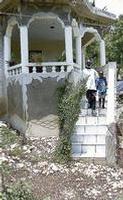
Melard Seymour Anderson with his grandson Chavez McKenzie at their Windsor Heights home in St. Catherine. - Junior Dowie/Staff Photographer
Back then, Sufferers Heights as a name captured the place. It is not one the residents want anymore. They now call the community Windsor Heights. The question though, is how to change the image of this community.
The physical landscape and housing in Windsor Heights, St. Catherine, have been improved significantly over the last three decades, but the community is still struggling to shed years of internal strife and conflict, which have created borderless divisions among its inhabitants.
Early settlement there dates back to the 1970s, a turbulent period in the country's political history, where it is reported that many fled volatile sections of the Corporate Area during political clashes to seek a place of abode and ended up in a number of squatter settlements.
Multiplicity of social problems
The community in its fledgling years had a multiplicity of social problems, marked by striking poverty, which permeated every nook and cranny of the area.
Decades have passed and it's not by chance that many who found themselves at the very bottom of the poverty line have "step up inna life", as one resident said.
Years of toil and sweat have transformed what was a litany of board and zinc shacks into concrete structures, many with middle-income architectural designs.
The mainly government-owned lands were surveyed in the 1990s, as well as in 2004, and residents got the opportunity to become legal owners of the lots they occupy.
Melard Seymour Anderson, an early resident of Windsor Heights, lives in Zambia, one of the many divisions in the south St. Catherine region. The 66-year-old resident has seen the community pass through many phases, expanding from an area which provided shelter for hundreds of people to a neighbourhood housing thousands of people.
Mr. Anderson and his wife, who have made the community their home since the late 1970s, raised seven children in Windsor Heights. Five are professionals working in the public and private sectors, while two have migrated to the United States and Canada, where they work in the accounting and technical fields.
Fruit of labour
The proud father recounts how he worked relentlessly to send his children to school and college and was happy today to see the fruit of his labour.
"I worked very hard, doing anything to send my children to school and to provide for their needs," he says.
Mr. Anderson's success story is no different from many of his neighbours' achievements. The community has produced professionals in various fields.
Windsor Heights, like many inner -city areas, grapples with the problem of crime and law-abiding citizens are clamouring for sustained peace in the community.
Divided, but only in part, along political party lines, the community has several sections including Sam Sharpe Square, China Town, Compound, Zion Lane, Elbow, Hillview, Makka Tree, Cagian Corner, Russell Avenue and Rock Land, among others.
According to one resident, persons are unable to move freely in some areas because of ongoing disputes between warring factions.
However, the lack of opportunities for youngsters in the community fuels the scourge of crime, which raises its ugly head too often in the area.
Wayne, otherwise called 'Bigga', a resident of Zambia, says he was once employed to Ashtrom Building Systems Limited, a company in close proximity to Windsor Heights, but was laid off over a decade ago, along with others. Since that time Wayne says he survives through informal commercial activities. He points out that many young men are overcome by frustration after several failed attempts to get a job. He posits a formula for reducing violence: "more work, less crime." John castigates politicians for ignoring the plight of residents, then showing up to solicit support close to an election.
Another major challenge facing residents is the lack of water, which was once supplied to large sections of the community from a tank, located on the top of a hill in Zambia.
Mr. Anderson says over the last 10 years, the precious liquid has not flowed from the tank, which has been in a state of disrepair. He says no attempt has been made by the National Water Commission to effect repairs. Efforts to get a comment from the NWC on the matter were unsuccessful.
Proper roads
Another cry of the residents is for the authorities to provide proper roads. "We are asking the Government to help us because we have no roads in this community," says Lloyd Frater, a resident.
But the creative energies of some residents were gainfully utilised in a project to construct a roadway. According to Mr. Frater, a team of men from Zambia took on the task using traditional methods, involving stones and mortar. The efforts of the residents have paid off today as the section of road provides critical access to houses on higher elevation.
Meanwhile, several businesses in Central Village and its environs are participating in a number of initiatives to assist the residents of Windsor Heights.
Wisynco Trading Company Limited employs a number of persons from the community in its factory and warehouse operations. According to its marketing assistant, Carlton Bartley, the firm also undertakes several outreach programmes, including sponsorship of football and netball competitions.
Lasco, another major manufacturer in close proximity to Windsor Heights, also employs residents from the community. The company sponsors a breakfast programme at the White Marl Primary and Junior High, where children from the community receive assistance.