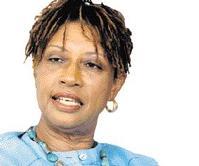
Beverley Anderson-Manley
One year ahead of the due date, there are elements within the Jamaican society that expect general elections within months. There are several factors that give rise to these expectations. Firstly, although the Gleaner's Bill Johnson polls show that the Prime Minister's ratings are "plunging", the voters she has lost are not yet supporting Bruce Golding. In addition, the People's National Party (PNP) continues to lead the Jamaica Labour Party by 38 per cent to 26 per cent - a margin of 12 per cent. In spite of this, the Bill Johnson polls predict a close race between the two political parties of 32 to 28 seats. In addition, Johnson admits that many of these seats are marginal. Hence, in spite of Portia Simpson Miller's popularity, Johnson is predicting a close seat count, bearing in mind that in the last general election there were several seats that were won by the PNP with less than 1,000 votes.
Bruce Golding Takes Charge
One of the differences this time around is that Bruce Golding has taken over the leadership of the JLP in a decisive way. Starting out with a party that was disunited and one that was highly suspicious of his leadership, he has spent time healing and uniting the party. This is not to say that some level of disunity does not exist but what it does say clearly is that overall, the party recognises that in order to win, it must unite. They have also begun to signal differences between themselves and the PNP.
Both political parties have announced that they are putting the finishing touches on their manifestos and we wait to see what the critical differences are - given that we have painted ourselves in a corner, that we are deeply embedded into a "debt trap" from which we are having great difficulty to escaping - and are involved in a vicious circle where we begin by borrowing, then we borrow again to service what we borrow. In their manifesto, it is expected that the JLP will tell voters how they will get us out of the trap and the vicious circle of debt, into a virtuous cycle that leads to substantial economic growth and jobs, jobs and more jobs.
Constitutional Reform
The JLP is already making it clear that they will pursue a programme of constitutional and political reform - some elements of which were part of the policies and programmes of the National Democratic Movement (NDM). It is expected that their manifesto will set out in more detail the nature of this constitutional reform and in particular, the type of indigenous "separation of powers" that will allow for less power concentrated in the hands of the executive - resulting in a more equal distribution of power among the arms of the state. Constitutional reform is not theoretical or abstract and must lead, among other things, to higher levels of representation at the constituency level alongside mechanisms for accountability and transparency.
Crime and Violence
While the number of homicides is decreasing and has been constant over the past six months, the Minister of National Security himself is making it clear that this does not represent a "turning point." We would have to see this kind of decline for a period of two to three years. The challenge is that these levels of decline are not sustainable, as the minister himself notes, without economic opportunities for the most vulnerable group in our society - young men in the age group up to 24 years old - the main perpetrators and victims of crime. There are so many more areas that need to be dealt with.
As general elections approach, whether in 2006 or 2007 - the critical issues that need to be dealt with remain with us. Nothing short of extraordinary leadership within systemic change can lead us from that vicious circle to a virtuous cycle.
And, finally, we have to find a way to fashion an educational system that can graduate students who are highly skilled and competent enough to access jobs anywhere in the world.
Beverley Manley is a political scientist and gender specialist. Email: BManley@kasnet.com.