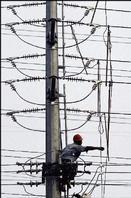
Maintaining power lines.
THE ARIMA Business Association (ABA) has condemned the decision to increase the cost of electricity from June 1.
In a media release, the ABA, headed by businessman Raj Jadoo, said if the Regulated Industries Commission (RIC) had considered previous recommendations by the group, the cost of electricity would have been much more affordable to consumers.
Households using more than 500 units of electricity per month will pay no increase on the first 500 units, but will pay a rate hike of 16 per cent on each additional unit of power, according to the T&TEC proposal as cited by an RIC official.
There are 150,000 households in T&T which consume less than 150 units of electricity per month, according to the RIC. The result is that lower income users of electricity, those using less electricity, will be spared from hefty increases in the cost of power, according to details of the Electricity Commission's (T&TEC) proposed rate hike.
In 2003 the Trinidad and Tobago Electricity Commission (T&TEC) collected J$15 billion in revenue but spent J$16.6 billion. An RIC document presented in May indicated that T&TEC's average tariff had declined by 35 per cent over the period 1993 to 2003 when adjusted for inflation.
The document also indicated that T&T had the lowest resident electricity rate in the Western hemisphere.
But now, with the latest rate hike, the people of T&T would be adversely affected, at a time, the ABA said, when inflation levels were skyrocketing.
DISASTER
"We again warn the powers-that-be that together with high inflation levels, escalating food prices, rising bank interest rates, increasing construction prices, severe shortages in labour and the increasing foreign exchange rates, this spells disaster for the spending public."
This increase would lead to a chain reaction from the gas pumps to the supermarkets, because all businesses use electricity to operate.
The tax breaks afforded through the last budget, the ABA stated, would be further eroded as people would have to dig deeper into their pockets to pay higher utility bills.
Paul Quesnel, president of the Trinidad and Tobago Manu-facturers' Association (TTMA) said he was concerned about the rate increase application.
Quesnel said almost every machine owned by manufacturers is run by electricity and the likely consequence would be an increase in the cost of production.
"This would make us less competitive in an environment where our exports have already decreased. It would mean losing market share and may lead to loss of jobs," he explained.
He pointed out that if rates were increased across the board then workers would face the brunt.
"It would further compound the situation for households who are already facing an increase in food prices. Now they will have to take money out of their pockets to pay their higher electricity rates," he explained.