
Laura Tanna
KENNETH M. BILBY, not a well-known name in Jamaica, will be by virtue of his incredible dedication to Jamaican history and culture.
I first heard of him in the early 80s when Beverley Hall-Alleyne, then head of the African Caribbean Institute of Jamaica (ACIJ), recommended I read in their library his manuscript, Kumina: A Kongo-Based Tradition in the New World, co-authored with Congolese scholar Fu-Kiau kia Benseki.
The thrill of sharing in their painstaking research, making specific connections between Kumina and the Congo, remains with me still.
Then, in 1986 when Hazel Carter was further researching the language of Kumina in back a bush St. Thomas, men asked if we knew this white man, Bilby, who could play Kumina drums so well. Their respect for him marked my memory.
Later, I saw the full version of his documentary film, Capital of Earth: The Maroons of Moore Town and was stunned by the intimacy of his knowledge of a people who so carefully guard their culture.
Now his latest book, True-Born Maroons, just published by Ian Randle Publications, reads in part like a novel, and so absorbed me that when I misplaced it, I tore the house apart for 20 minutes searching until I found it to continue reading.
SPECIFIC QUEST FOR KNOWLEDGE
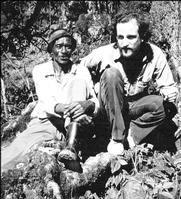
Author Kenneth Bilby (right) with Maroon oral historian and storyteller Hardie Stanford in Moore Town, Portland (1982). - CONTRIBUTED
His knowledge and understanding of Jamaican Maroons has simmered for years, percolating through layer upon layer of learning from different perceptions and periods of time, maturing with him to give us something of such value that I will discuss that with you in more detail.
First, I want to understand why a person born and raised in New York devotes his life to this specific quest for knowledge.
"I was attracted to the sheer cultural energy of urban Jamaican music in the 70s, along with the concern for social justice and the calls for social change it carried," Ken explains. "As a budding ethnomusicologist, I was especially interested in the deeper social and cultural 'roots' of the music. I also discovered Olive Lewin's work (by reading Jamaica Journal, and visiting the Institute of Jamaica, Jamaican bookstores, etc.); her work had a big impact on me. Also George Eaton Simpson's and Edward Seaga's earlier field recordings on the Folkways label. It was a special time. All these things were coming together for me personally. Marley's rise as the first 'Third World rock star,' and, before long as a global musical and cultural force, made all the things I was beginning to study seem that much more significant."
Bilby's B.A. thesis for a first degree in anthropology from Bard in 1976 was a historical study of African-Jamaican music and religion through 18th- and 19th-century sources, incorporating his first fieldwork on Kumina.
IMPECCABLE CREDENTIALS
A tall, thin, quiet man, Bilby's academic credentials are impeccable. His master's degree at Wesleyan University, where he immersed himself in their world-class ethnomusicology programme, was followed by a doctorate from the Johns Hopkins University, studying under two renowned Caribbeanists, Sidney Mintz and Richard Price.
He also completed the ethnographic film programme at Harvard University, and was curator and research associate at the Smithsonian Institution and a scholar-in-residence at the Schomburg Center for Research in Black Culture in New York.
His academic credentials could not be better, but it is his life experience, living with and learning from Caribbean people about their own cultures, giving voice to their wisdom in their own words, while still making reference to contemporary scholarship, as well as cross-checking with archival sources, before fluently and sensitively sharing all that knowledge with us, that makes Bilby so special.
His great grandmother married an English military man stationed in Jamaica, so in the early 1900s, his grandmother spent much of her childhood here.
She moved back to Jamaica in the 1930s and throughout his childhood Bilby regularly visited his grandmother in St. Ann, creating his affinity with Jamaica and its culture. Significantly, he notes:
"One key memory: when I was 15, I came upon an original edition of Dallas' two-volume History of the Maroons (1803) and was amazed. Although I'd heard about the Maroons, it was always some sort of vague, mythological reference to 'those people up in the hills.' After reading Dallas, I couldn't believe that more was not known about them and their story; they seemed lost to history. Nothing was taught about them in schools, at least in the U.S. It was such an inspiring story! That always stuck with me."
FIELD EXPERIENCE
Bilby lived in the Soho/Middleton area of St. Thomas in 1975/76 studying Kumina, then lived in Moore Town in 1977/78, returning to learn more from people in Scot's Hall, Accompong, Charles Town and other areas of St. Elizabeth, for a total of 10 fieldwork experiences in Jamaica between 1975 and 2005.
His doctoral dissertation was actually based on fieldwork amongst the Aluku Maroons of French Guiana in South America, with whom he lived in 1983/84, 85/87, 1990, 1991 and 1995.
His knowledge of the Caribbean includes work and field recordings in Antigua, the Bahamas, Belize, Costa Rica, St. Vincent, Dominica, Suriname as well as fieldwork in the Netherlands and Sierra Leone.
"But," he says, "of all the places I've worked, I feel a special connection with, a love and respect for, Jamaica - the people and the culture."
He says: "It was at a Kumina ceremony in West Kingston in 1976 that I happened upon a visiting Maroon who urged me to come to Moore Town; Dallas's book came right back to me (along with other things I'd read since) and that's when I decided to explore the possibility of doing fieldwork in a Maroon community. After a short time in Moore Town, starting in 1977, that was it. I was hooked: as I say in the preface to True-Born Maroons, that turned out to be 'a life-changing experience'."
Next: Sharing the secrets without breaking the trust