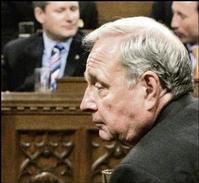
Canada's Prime Minister Paul Martin sits across from Conservative leader Stephen Harper (top left) during a vote in the House of Commons on Parliament Hill in Ottawa on Monday. - REUTERS
OTTAWA, (Reuters):
PRIME MINISTER Paul Martin launched an election campaign yesterday with a slim lead in the polls after his minority government was toppled in Parliament on Monday night over a corruption scandal.
Martin informed Governor-General Michaelle Jean, representative of head of state Queen Elizabeth, that his Liberal government had lost the confidence of Parliament and emerged from her official residence to announce the election would be on January 23.
FIFTH TIME
It was the fifth time in Canadian history that a minority government had been toppled by the opposition, in this case one emboldened by official findings that kickbacks had been used illegally to finance Liberal election campaigns.
Martin accused the opposition of cynicism and said it brought down the government for no good reason.
"A minority Parliament means the opposition can force an election whenever it chooses. In this case, I believe ambition has overwhelmed common sense," he told reporters in the rain outside Rideau Hall, the governor-general's residence.
The Liberals, who have governed a majority of the time since Canada was founded in 1867, will be seeking their fifth straight term since the Conservatives went down to defeat in 1993.
EXONERATED
Martin's task is to deflect attention from the kickbacks scandal and judicial findings of a Liberal "culture of entitlement". He will point out that he was personally exonerated and will seek to show that the Liberals are the party of the future.
All three opposition parties have said they will focus on clean government in their campaigns, but they also must roll out ideas to persuade the public they are not just anything-but-Liberals.
The Conservatives, the only party besides the Liberals with a hope of forming a government, are pressing for deep tax cuts, tougher penalties for violent crime, and a less combative relationship with the United States.
The other two opposition parties, the separatist Bloc Quebecois and the left-leaning New Democratic Party, look set to gain enough seats to make it unlikely that either the Liberals or Conservatives will get a majority in Parliament.
LIBERALS LEADING
Polls give the Liberals a lead of five to six percentage points over the Conservatives. But the Liberals are only at 35 to 36 per cent support, shy of the 40 per cent that is seen as a bare minimum to get a majority.
A Strategic Counsel poll in yesterday's Globe and Mail newspaper put the Liberals at 35 per cent, the Conservatives at 29 per cent and the NDP at 17 per cent.
The biggest thorn in the Liberals' side is the crushing dominance of the Bloc Quebecois in Quebec, where the kickbacks scandal was centred. The Bloc won 54 of the 308 seats in the House of Commons in the last election and looks set to retain most of them.
A CROP poll in yesterday's La Presse put the Bloc Quebecois ahead of the Liberals at 53 per cent to 23 per cent in Quebec.
Martin blamed the opposition for forcing a campaign that will span the Christmas season, while he had been offering to call an election in April.
The opposition had proposed another alternative, dissolving Parliament in January for a February election, but Martin rejected that, leading to the defeat of his government.


















